You noticed. Of course you noticed.
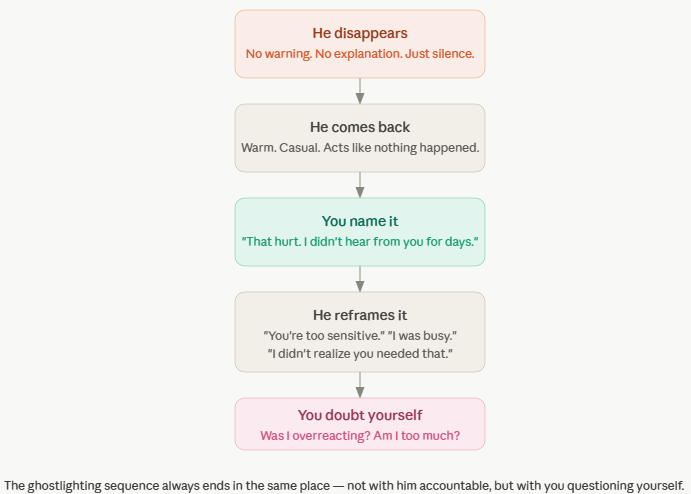
He went quiet for days — no texts, no explanation, just silence where there used to be warmth. And when he finally came back, acting like nothing happened, you said something. Gently, carefully, honestly. You told him it hurt.
And somehow, by the end of that conversation, you were the one apologizing.
That’s ghostlighting. And if it’s happened to you, the most important thing to know is this: your perception was correct. You weren’t overreacting. Something did happen — and then someone worked very hard to make you doubt that it did.
What Ghostlighting Actually Is
Ghostlighting is a combination of two painful relationship patterns: ghosting and gaslighting.
Ghosting is when someone disappears without explanation — no warning, no closure, just silence. It’s confusing and hurtful on its own.
Gaslighting is when someone manipulates you into questioning your own perception of reality. Over time, it makes you doubt your instincts, your memory, and your right to feel what you feel.
Ghostlighting combines both. He disappears. Then he returns — and instead of acknowledging the absence, he acts like it never happened. Or he reframes it entirely. “I told you I was busy.” “You’re being too sensitive.” “I didn’t realize you needed constant check-ins.”
“Ghosting ends the story. Ghostlighting keeps it alive in a half-lit state — just enough connection to stay, not enough clarity to heal.”
The result is a specific kind of disorientation. You know what happened. But now you’re not sure if what you know is real. And somehow the conversation has shifted from his disappearance to your reaction to it.
The Signs You’re Being Ghostlighted
Ghostlighting doesn’t always look dramatic. Sometimes it’s subtle enough that you only recognize it in hindsight. Here are the patterns worth knowing:
- He disappears without explanation, then returns as if nothing happened. No acknowledgment of the gap. No apology. Just warmth, as if you’d both simply been busy.
- When you bring it up, he reframes your hurt as the problem. Suddenly the conversation is about you being “needy,” “insecure,” or “too much” — not about his absence.
- He denies the reality of what happened. “I wasn’t gone that long.” “You’re imagining things.” “That’s not what happened.”
- He makes you feel like your expectations are unreasonable. After enough of these conversations, you start to wonder if you’re asking for too much. You’re not.
- You end up apologizing. Not him. You.
Why He Does It
Understanding the why doesn’t excuse the behavior — but it does help you stop personalizing it.
For some men, ghostlighting comes from a deep discomfort with conflict and accountability. Disappearing felt easier than having a hard conversation. But when you call it out, they can’t face the shame of what they did — so they deflect it back onto you.
Avoidant attachment plays a significant role here. People with avoidant patterns often struggle to handle emotional confrontation. Rather than saying “I needed space and I handled it badly,” they find it easier to make your reaction the issue. It keeps them from having to look at their own behavior.
Sometimes it’s more calculated — a way to keep you uncertain, off-balance, and less likely to hold firm boundaries. When you’re busy questioning your own perception, you’re not focused on whether this relationship is actually working for you.
And sometimes it’s simply emotional immaturity — someone who never learned to take responsibility for how their behavior affects the people they’re close to. If this sounds familiar, 7 Signs He Is Emotionally Immature (And What It Means for Your Future)is worth reading.
What It Does to Your Inner World
The most insidious part of ghostlighting isn’t the disappearance itself. It’s what it does to your relationship with your own mind.
When someone repeatedly tells you that what you perceived didn’t happen — or that your response to it is the real problem — you start to distrust yourself. Your instincts feel unreliable. Your emotions feel like liabilities. You begin editing yourself before you even speak, trying to predict whether your feelings will be labeled “too much” again.
This is the hallmark of gaslighting’s damage: not just confusion about him, but a growing uncertainty about yourself.
If you’ve started to feel like you’re always the one who’s “too sensitive,” always the one whose reaction is disproportionate, always the one who ends up walking the conversation back — that pattern is telling you something. Not about your emotional health, but about his.
“You didn’t become confused because you’re weak. You became confused because someone kept rearranging the furniture and then told you you’d imagined it.”
The Difference Between Ghostlighting and a Simple Misunderstanding
Not every disappearance is ghostlighting. Life happens — people get overwhelmed, communication breaks down, sometimes someone genuinely didn’t realize how long they’d been quiet.
The difference lies in what happens when you bring it up.
In a healthy relationship, your partner hears that their absence hurt you and responds with care — even if they were dealing with something real. They don’t make you feel irrational for noticing. They don’t turn their absence into a referendum on your needs.
Ghostlighting is characterized by the double move: first the disappearance, then the reframing of your response. It’s not a one-time misunderstanding. It’s a pattern — and patterns are the most reliable information you have about a relationship.
You can read more about what emotional unavailability really looks like beneath the surface in Why Do I Feel Alone in My Relationship? The Real Signs of Emotional Unavailability.

How to Respond When It’s Happening
If you recognize this dynamic in your relationship, here are some grounded ways to respond.
1. Trust what you observed.
You noticed the absence. That’s real. Before any conversation happens, get clear with yourself: this happened, and it affected me. Don’t let the reframing begin before you’ve even spoken.
2. Name the pattern, not just the moment.
Instead of defending your reaction, describe what you’ve observed: “When you go quiet for several days and then come back without acknowledging it, I feel confused about where I stand with you.” Keep the focus on the behavior, not the argument about whether your feelings are valid.
3. Watch how he handles accountability.
Does he listen? Does he acknowledge what happened — even imperfectly? Or does the conversation always end with you managing his discomfort instead of your own?
4. Stop auditing your own feelings.
Your hurt doesn’t need to meet a certain threshold to be legitimate. You don’t need to prove that the absence was “long enough” or your response “justified enough.” You felt what you felt.
5. Consider what you’re willing to accept.
If this is a recurring pattern — if you regularly feel crazy for noticing real things — that’s not a communication problem that better wording will solve. That’s a relationship dynamic that needs to be honestly evaluated.
For more on reclaiming your voice when your emotional needs are consistently minimized, When Emotional Needs Go Unmet: What It Does to You and How to Reclaim Your Voice goes deep on exactly this.
Rebuilding Trust in Yourself
Recovering from ghostlighting isn’t just about leaving or staying. It’s about returning to yourself.
It means practicing the habit of trusting your first perception — before anyone else has the chance to reframe it. It means noticing when you’re explaining your feelings rather than expressing them. It means giving yourself permission to feel hurt without immediately cross-examining whether the hurt is “reasonable.”
You don’t need external validation to know that something felt wrong. If it felt wrong, that matters. Your perception is not a problem to be solved. It’s information — and it belongs to you.
Journaling Prompts
- Think of a time when you felt something was wrong, then talked yourself out of it after a conversation with him. What did you originally notice — and what made you doubt it?
- How has this pattern affected the way you express your needs? Do you find yourself softening, qualifying, or apologizing before you’ve even finished a sentence?
- What would it feel like to trust your first instinct completely — to let it stand without needing someone else to confirm it?
Q&A – About Ghostlighting
Is ghostlighting the same as gaslighting?
They overlap, but they’re not identical. Gaslighting is a broader pattern of making someone doubt their reality over time. Ghostlighting is a specific sequence: disappearing without explanation, then returning and reframing your hurt response as the problem. Ghostlighting is always a form of gaslighting, but gaslighting doesn’t always involve ghosting first.
Can ghostlighting happen in long-term relationships, not just dating?
Absolutely. In longer relationships it can look like emotional withdrawal — going cold for days — followed by a return to normal with no acknowledgment of what happened. When you bring it up, you’re told you’re “dwelling” or “making it a bigger deal than it is.”
Is he doing it on purpose?
Not always. Some people ghostlight out of conflict avoidance and shame — they genuinely don’t know how to handle accountability, so they deflect. But whether it’s conscious or not, the impact on you is the same. Intent matters for understanding him; it doesn’t change what you experienced.
How do I know if I’m being too sensitive?
This is exactly the question ghostlighting is designed to make you ask. A useful reframe: in a relationship where you felt consistently secure and heard, would this same situation make you feel “too sensitive”? Sensitivity is often a response to an environment — not a personality flaw.
What’s the best way to respond when he comes back like nothing happened?
Don’t match his energy right away. Give yourself a moment to get clear on what you actually want to say before the warmth of his return pulls you back in. A calm, clear observation — “I want to talk about what happened” — said before the reconnection fully settles is more effective than bringing it up later, after you’ve already re-bonded.
I share more thoughts on love, attachment, and growth over on Pinterest — come find me there.
With love – Zsana