Nobody tells you the truth about the first year of marriage.
They tell you it’s the happiest time of your life. They tell you love is enough. They tell you not to go to bed angry — as if navigating two fully formed people merging their lives, their habits, their attachment wounds, and their expectations is something that can be solved by staying up late to finish an argument.
The first year of marriage is one of the most meaningful and most disorienting experiences a relationship goes through. Not because anything is wrong, but because you’re building something from scratch — and nobody hands you the blueprints.
Here’s what I wish someone had told me before I started.
The Adjustment Is Real — and It Doesn’t Mean Something Is Wrong
One of the most damaging myths about the first year of marriage is that it should feel like an extended honeymoon. That if it’s hard — even occasionally, even in small ways — something has gone wrong.
It hasn’t. What’s happening is normal.
You’re not just sharing a home. You’re discovering how two different nervous systems, shaped by two different childhoods, respond to stress, conflict, intimacy, and day-to-day friction. You’re negotiating everything from who does the dishes to how you handle disappointment to what “enough affection” looks like.
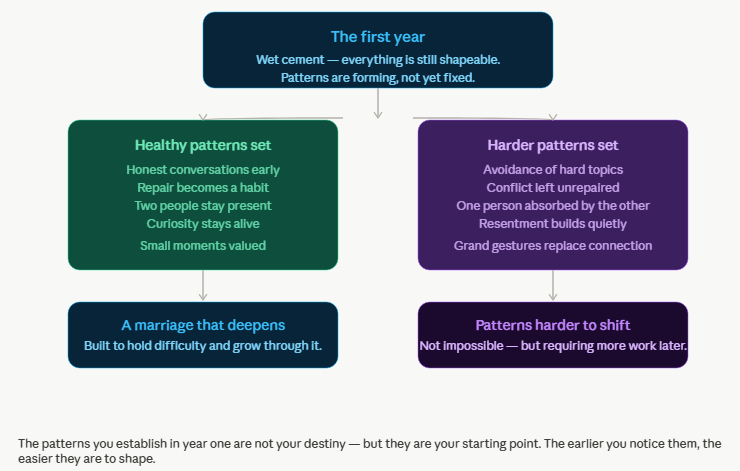
A therapist once described the first year of marriage as “the wet cement year.” It’s the period when patterns get established — the habits of communication, repair, and connection that will shape the marriage for decades. That framing changed everything for me. It meant the work mattered. It also meant the discomfort was part of the work, not evidence that something was broken.
“The first year isn’t about getting it right. It’s about figuring out, together, what right looks like for the two of you.”
You Are Still Two Separate People
This sounds obvious. It stops feeling obvious about three months in.
There’s a particular gravitational pull in early marriage toward merging — toward becoming so interwoven that the distance between “I” and “we” disappears completely. It feels like love. Sometimes it is love. But over time, that erasure of individuality creates problems that are genuinely hard to untangle.
You are allowed to have friends he doesn’t know well. Interests he doesn’t share. Opinions that differ from his. A sense of self that exists independently of the marriage.
In fact, that separateness is what makes genuine intimacy possible. You can only be truly close to someone if there are actually two people present. A marriage where one person has dissolved into the other isn’t intimacy — it’s absorption.
Hold onto who you are. Keep the friendships. Maintain the things that make you you. Not in opposition to the marriage, but alongside it.
Learn How Each of You Fights — Before the Fights Get Big
Conflict in marriage is not the problem. Unexamined conflict is.
In the first year, you’ll have your first real fights — not dating arguments, but the kind that come from actually sharing a life. How you navigate those moments early on establishes the pattern for how you navigate them for years.
Some things worth noticing: Does one of you shut down and need space while the other needs to talk it through immediately? Does either of you say things in anger that you don’t mean? What does repair look like — who usually initiates it, and does it feel genuine?
These patterns are not fixed. But they’re much easier to work with when you can see them clearly. Gottman’s research identified four communication patterns most predictive of long-term relationship breakdown: criticism, contempt, defensiveness, and stonewalling. Recognizing when these appear — in yourself as much as in him — gives you somewhere to start.
The goal isn’t to never fight. It’s to fight in a way that leaves you both still on the same team when it’s over.
Disappointment Is Inevitable. It Doesn’t Have to Be Devastating.
One of the most quietly painful experiences in early marriage is the moment you realize your partner is not who you thought he was — or more precisely, that he is exactly who he is, which is not a character in your imagination.
He will disappoint you. Not because he doesn’t love you, but because he’s human. He won’t always know what you need. He’ll get the timing wrong. He’ll handle something in a way that leaves you feeling alone.
How you navigate disappointment in the first year matters enormously. Because the pattern you establish — do you talk about it, or let it calcify into resentment? do you make room for repair, or keep a quiet ledger? — becomes the pattern you live inside.
Learning to say “that hurt, and I need to talk about it” before the hurt becomes a wall is one of the most valuable skills you can build in the first year. It’s also one of the hardest, because it requires trusting that the relationship can hold your honesty.
It can. Usually more than you think.
The Small Moments Are the Marriage
There’s a tendency in the first year to invest heavily in the big things — the vacations, the milestones, the romantic evenings — while underestimating the enormous weight of ordinary Tuesdays.
But research consistently shows that what holds marriages together is not the grand gestures. It’s the accumulated texture of small moments: turning toward each other when one of you reaches out, repairing quickly after friction, maintaining genuine curiosity about each other’s inner life even when the novelty has faded.

John Gottman’s concept of “bids for connection” — the small moments when one partner reaches toward the other — is one of the most practically useful frameworks I’ve encountered. How you respond to those bids, in the unremarkable moments of a regular day, is doing more work than you realize.
A hand on the shoulder. Actually listening instead of half-listening. Saying “tell me more” when he starts talking about something. Noticing when something is off and asking.
These are small. They compound.
Talk About Everything Before It Becomes an Argument
Money. Family visits. What “clean enough” means. Who carries the mental load. How often you want to have sex. What you do with difficult feelings. Whether you want children, and when.
Many couples avoid these conversations in the first year because they don’t want to introduce friction into the warmth of newlywed life. But unspoken expectations don’t disappear — they build pressure, quietly, until they explode in a fight that seems to be about something else.
The most useful conversations you can have in the first year are the ones that feel slightly too formal or vulnerable to initiate. “How do you think about money — what did you learn from your family?” “When you’re stressed, what do you actually need from me?” “Is there something I do that makes it hard for you to feel close to me?”
These aren’t crisis conversations. They’re the kind that build the map you’ll navigate by for years. The earlier you draw them, the less lost you get.
For more on the conversations most couples avoid but need most, The Conversations Most Couples Are Afraid to Have (And Why They Change Everything) is worth reading together.
You Will Both Change. Plan for It.
The person you married at 28 or 32 or 36 will not be exactly the person you’re married to at 45. You will both grow, shift, revise your understanding of yourselves and each other. Some of those changes will align and deepen what you have. Some of them will require renegotiation.
Marriages that survive and thrive over decades are almost never the ones that stayed frozen. They’re the ones where both people stayed genuinely curious about each other — where the question “who are you now?” kept being asked and answered, long after the wedding.
The first year is a chance to establish that curiosity as a norm. To be the couple that keeps learning each other rather than the couple that assumes they already know.
Ask for Help Earlier Than You Think You Need To
Couples therapy carries a stigma it doesn’t deserve — the assumption that you go when things are already dire.
But the most effective time to invest in couples support is before the patterns have calcified. In the first year, when you’re still figuring out how you work together, a few sessions with a good therapist can give you tools and language that take years to develop on your own.
It’s not a sign that your marriage is failing. It’s a sign that you’re taking it seriously.
What Nobody Tells You About Love
Love in marriage isn’t a feeling you maintain. It’s a practice you return to — again and again, through the ordinary friction of sharing a life, through disappointment and repair, through the years that look nothing like the wedding day.
There will be stretches where you feel it easily. Stretches where you have to choose it more consciously. Both are real. Both are marriage.
What holds through all of it isn’t passion, though passion has its place. It’s something closer to the quiet commitment to keep showing up — to keep being curious about this person, to keep choosing to repair when things break, to keep building toward something neither of you can fully see yet.
That’s what no one told me. And it’s the thing I most wish I’d known going in.
“Marriage is not a feeling you sustain. It’s a practice you return to — every day, in the small moments, for as long as you both choose it.”
Journaling Prompts
- What expectations did you bring into your first year of marriage — spoken or unspoken — that turned out to be different from reality? How did you navigate that gap?
- What’s one conversation you and your partner haven’t had yet that you know you need to have? What’s made it feel hard to start?
- What does “returning to each other” look like in your marriage — what do repair and reconnection actually feel like when they’re working?
Frequently Asked Questions About the First Year of Marriage
Is it normal to struggle in the first year of marriage?
Completely. The first year involves enormous adjustment — two people with different histories, habits, and nervous systems learning to share a life. Struggle doesn’t signal incompatibility. It signals that you’re doing the real work of building something, not just the honeymoon version of it.
Why do so many couples fight more after getting married?
Because marriage raises the stakes of everything. Conflict that felt manageable in dating carries more weight when you’re building a life together. The fights also tend to be about real things — expectations, needs, differences in how you handle stress or intimacy — that were easier to overlook before you were living inside each other’s daily reality.
How important is sex in the first year of marriage?
Physical intimacy is one of the primary ways couples maintain connection — and the patterns established early tend to persist. More important than frequency is whether both partners feel seen and desired, and whether differences in need or timing can be talked about openly rather than becoming a source of shame or distance.
What are the most common mistakes couples make in the first year?
Avoiding difficult conversations to preserve the peace, venting to friends or family about the marriage instead of addressing things directly with each other, and expecting the marriage to feel easy rather than recognizing that good marriages require ongoing investment.
When should we consider couples therapy in the first year?
You don’t have to wait for a crisis. Many couples find that a few early sessions — when they’re establishing patterns rather than entrenched in problems — give them tools that serve them for decades. If a particular issue keeps recurring without resolution, that’s a clear signal that an outside perspective would help.
I share more thoughts on love, attachment, and growth over on Pinterest — come find me there.
With love – Zsana