There’s a question most of us never ask out loud, but that lives underneath almost everything we do in a marriage.
Am I safe here?
Not physically safe — most of us know the answer to that. But emotionally safe. Safe to be uncertain, to be afraid, to need something, to be wrong, to be the full, complicated, imperfect version of ourselves — and trust that none of it will be used against us.
That’s emotional safety. And it might be the most important thing a marriage can offer.
What Emotional Safety Actually Is
Emotional safety is not the absence of conflict. It’s not a relationship where everything is always fine, where no one ever gets hurt or says the wrong thing.
It’s something more specific: the felt sense that you can bring your real self into this marriage and survive it. That you can be scared, or sad, or struggling, or angry — and your partner will not disappear, shut down, or weaponize what you’ve shared later.
Underneath every intimate relationship, two questions are being asked, constantly and quietly: Am I loveable? And Are you accessible? Emotional safety is what happens when both of those questions are answered with yes — not once, but consistently, over time.
This is why emotional safety feels different from comfort. Comfort is pleasant. Safety is foundational. You can be uncomfortable and still feel safe. But without safety, even a comfortable marriage can feel hollow — because you’re never quite fully there in it.
“Emotional safety is not the opposite of conflict. It’s the ground that makes conflict survivable — and connection possible.”
What It Feels Like When It’s Present
Emotional safety has a particular texture. It’s quiet, mostly. You stop noticing it the way you stop noticing solid ground beneath your feet.
When it’s present:
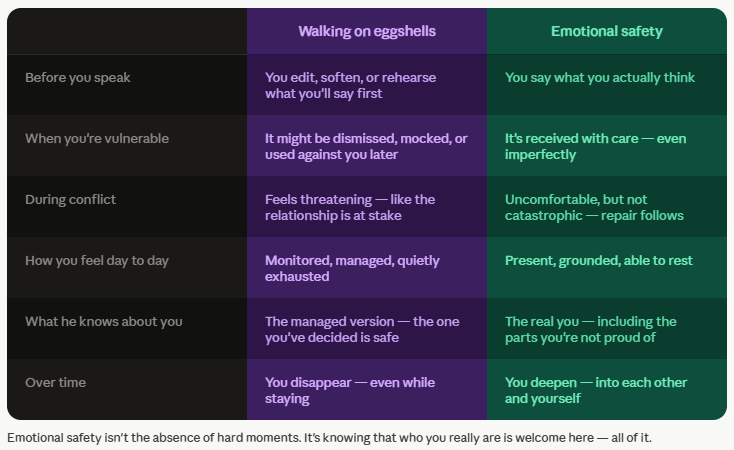
- You say what you actually think. Not the edited, pre-approved version. The real one.
- You can be in a bad mood without managing his reaction to it. You don’t have to perform okayness.
- Conflict doesn’t feel existential. You can disagree and still know, somewhere underneath the disagreement, that you’re okay.
- Vulnerability is met with care, not criticism. When you share something tender, he receives it gently — even imperfectly.
- Your past words aren’t used as ammunition. What you share in a vulnerable moment stays in that moment. It doesn’t get filed away and deployed against you later.
- You can say no. To sex, to a plan, to a conversation you’re not ready for — without it becoming an incident.
None of these are dramatic. They’re quiet. But their absence is loud.
What It Feels Like When It’s Missing
Walking on eggshells is the phrase most people use. And it’s accurate — that constant low-level monitoring of the environment before you speak, calibrating what you can and can’t say, editing yourself so relentlessly that the real you barely shows up at all.
When emotional safety is missing, you start to protect yourself. You share less. You keep the harder feelings to yourself. You learn which topics cause problems and navigate around them. And over time, you find yourself in a marriage with someone who knows your schedule and your preferences and the broad strokes of your life — but doesn’t really know you.
The absence of emotional safety doesn’t always look dramatic. It can look like a perfectly functional marriage where two people are quietly, separately lonely.
If this resonates, When You’re Lonely in Your Own Marriage: Understanding Emotional Distance explores what that experience feels like from the inside.
How Emotional Safety Gets Damaged
Safety doesn’t usually shatter in a single moment. It erodes.
A comment that landed like criticism when you were already vulnerable. A time you shared something tender and it was dismissed or met with a joke. A moment when you were upset and he turned away instead of toward you. A conflict where something you’d confided in a soft moment got brought back up as evidence against you.
Individually, these things might seem small. But they teach the nervous system something: this is not fully safe. And once that lesson is learned, the nervous system starts protecting itself. The walls go up not because you decided to put them there, but because the body is doing what bodies do — keeping you out of harm’s way.
This is why emotional safety, once damaged, requires more than good intentions to repair. It requires consistent, repeated proof that things are different now.
How to Build — and Rebuild — Emotional Safety
Listen without planning your response.
Real listening — the kind that makes someone feel heard — means giving your full attention before you think about what to say. When your partner shares something, resist the urge to fix, defend, or redirect. Just hear it. Reflect it back. Let them feel understood before anything else happens.
Validate feelings you don’t agree with.
You don’t have to agree with how your partner feels to acknowledge that they feel it. “That makes sense that you felt hurt by that” is not a confession. It’s an act of respect. Validation builds safety faster than almost anything else — because it signals that feelings are welcome here, not judged.
Keep vulnerable things safe.
What your partner shares from a soft, open place should stay there. Not brought up in arguments. Not used to score points. Not mentioned to others. This is one of the most fundamental forms of trustworthiness in a marriage — and one of the most commonly broken.
Repair, even when it’s hard.
After conflict or disconnection, repair matters. It doesn’t have to be elaborate — a hand on the shoulder, a genuine “I’m sorry I said that”, a moment of turning back toward each other. What makes safety is the consistency of repair. The knowledge that after hard moments, you find each other again.
Be predictable in the ways that matter.
Emotional safety is built from thousands of small, consistent moments — not from grand gestures. When your reactions are reliable, when your partner knows roughly what to expect from you in a hard moment, safety grows. Unpredictability — especially emotional unpredictability — is one of the fastest ways to erode it.
You can explore more about what consistent presence looks like in The Difference Between a Partner Who Cares and One Who’s Present.
The Connection Between Safety and Intimacy
Here’s something counterintuitive: emotional safety and passion are not opposites.
Many people assume that safety means predictability, and predictability means boredom. That real intimacy requires a certain edge of uncertainty, that the spark comes from not quite knowing where you stand.
But research consistently points the other direction. Couples who feel emotionally safe with each other tend to have deeper, more satisfying intimacy — physical and emotional. Safety is not the enemy of desire. It’s the ground that real desire grows from. When you’re not spending energy protecting yourself, you have energy for something else.
What kills intimacy isn’t safety. It’s the chronic low-level guardedness that comes from not feeling safe. The performance. The management. The half-presence that’s all you can manage when part of you is always watching the door.
“You can’t be fully present with someone you don’t feel safe with. And presence is what intimacy is made of.”
A Note on Safety That Can’t Be Rebuilt
Most of what’s in this article assumes a relationship where safety has been imperfect but not systematically destroyed — where the erosion has been gradual and unintentional, and where both people are willing to do the work.
But emotional safety that is chronically, deliberately undermined — through contempt, humiliation, gaslighting, or the systematic dismissal of your perceptions — is a different situation. Not every relationship that feels unsafe can be made safe through better communication or more vulnerability. Some dynamics require more than that.
If you frequently feel afraid, humiliated, or destabilized in your marriage — not just hurt or frustrated, but genuinely unsafe — that’s important information that deserves honest attention, and possibly professional support.
Journaling Prompts
- When do you feel most emotionally safe with your partner? What’s present in those moments — and what makes them different from the moments you feel guarded?
- Is there something you’ve stopped sharing with him — a feeling, a need, a truth about yourself — because somewhere along the way it stopped feeling safe to? What taught you that?
- What would it mean for your marriage if both of you felt genuinely safe enough to be fully yourselves? What would be different?
Frequently Asked Questions About Emotional Safety in Marriage
How do I know if my marriage lacks emotional safety?
Common signs include feeling like you’re walking on eggshells, editing what you say before you say it, feeling judged or dismissed when you share vulnerable feelings, or noticing that things you’ve shared in soft moments get brought up against you in arguments. Emotional safety is present when you can be your full self — including the messy, uncertain parts — without fear of what that will cost you.
Can emotional safety be rebuilt after it’s been broken?
Yes, but it requires consistent action over time — not just apologies or good intentions. Rebuilding safety means showing up differently, repeatedly, until the nervous system has enough new evidence to start trusting again. This often benefits from the support of a couples therapist who can help both partners understand what happened and what needs to change.
Is emotional safety the same as never fighting?
No. Couples who feel emotionally safe still fight — sometimes intensely. The difference is that conflict doesn’t feel like a threat to the relationship’s survival, and repair happens afterward. Safety is not the absence of hard moments. It’s the presence of trust that you’ll find each other after them.
What’s the difference between emotional safety and just being comfortable?
Comfort can exist without safety — and safety can exist without comfort. Emotional safety specifically means you can be vulnerable, honest, and imperfect without fear of judgment, criticism, or rejection. A comfortable marriage where you’ve learned to avoid anything that might cause friction isn’t the same as a safe one.
What if I want to build more emotional safety but my partner doesn’t seem interested?
Start with yourself. One person choosing to respond differently — with more curiosity, less defensiveness, more repair — can shift the dynamic over time. But if your attempts to build safety are consistently met with contempt, dismissal, or escalation, that’s a signal that the issue is bigger than communication strategies. Couples therapy is worth exploring.
I share more thoughts on love, attachment, and growth over on Pinterest — come find me there.
With love – Zsana