“Know your worth” gets said a lot.
On Instagram, in advice columns, in the texts friends send when you’re crying about someone who didn’t treat you well. It sounds simple. It sounds like something you should already know.
But if you ask most women what it actually means — in practice, in a real relationship, on a Tuesday when things are hard — the answer gets complicated fast.
Because knowing your worth isn’t a feeling you arrive at once and keep forever. It’s not confidence in the way confidence is usually described. And it’s definitely not about thinking you’re better than anyone else.
It’s something quieter, and more foundational, than most people realize.
What Self-Worth Actually Is
Self-worth is the belief — held at a felt, bodily level, not just an intellectual one — that you are inherently valuable. Not because of what you do, what you look like, how agreeable you are, or how much you give. But because you exist, and your experience matters, and you are worthy of being treated with care.
That’s it. That’s the whole thing.
But here’s what makes it complicated: most of us weren’t raised to believe this without condition. We were taught, directly or indirectly, that love is earned. That approval must be maintained. That being easy, useful, agreeable, or exceptional is what makes you worth loving.
And so we carry that into relationships. We work to maintain being loveable rather than simply trusting that we are. We tolerate things we shouldn’t because somewhere underneath, we’re not sure we deserve better. We confuse someone choosing us with proof of our worth — and when they don’t, we spiral.
“Your worth is not something another person gives you by choosing you. It’s something you either already believe about yourself — or you don’t.”
What It Looks Like When You Don’t Know Your Worth
The signs aren’t always obvious. Knowing your worth doesn’t look like confidence in the usual sense — you can be perfectly capable and accomplished in every other area of life, and still not know your worth in love.
Here’s what it looks like instead:
- You work harder than he does to maintain the relationship. You’re the one initiating, apologizing, adjusting, making it work. And somehow it never feels like enough.
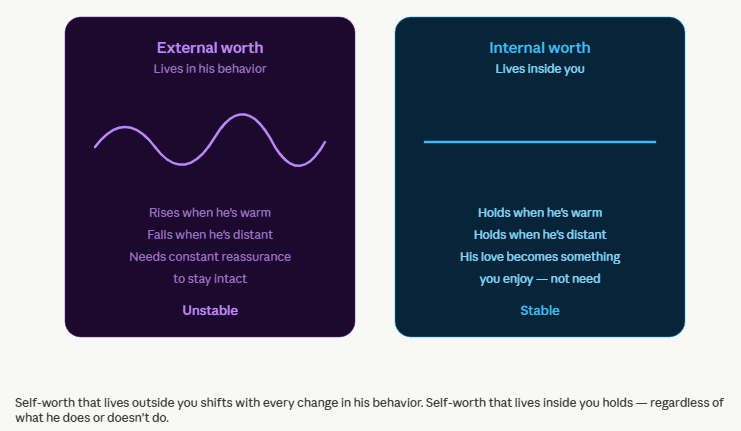
- You measure your value by his behavior. When he’s warm, you feel good about yourself. When he’s distant or critical, you spiral — trying to figure out what you did wrong.
- You accept treatment you know isn’t okay. Not because you don’t see it, but because part of you believes you can’t expect better, or that this is what you deserve, or that love always involves this much uncertainty.
- You seek constant reassurance. Not because you’re needy, but because your sense of being loved depends on him confirming it — regularly, urgently.
- You lose yourself in the relationship. Your preferences, friendships, and sense of self start to shrink as his reality expands to fill the space.
- You stay in things you know aren’t working. Because leaving feels like confirmation of the fear: that you’re not worth someone treating you well.
None of these are character flaws. They’re responses to a belief — a belief that was usually installed long before this relationship began.
Where Self-Worth Actually Comes From
This is the part that gets misrepresented most.
Self-worth doesn’t come from him choosing you. It doesn’t come from how the relationship is going. It doesn’t come from being told you’re beautiful or smart or loved — though all of those things feel good.
It comes from your relationship with yourself.
Research from Psychology Today confirms what therapists have known for years: reassurance and external validation don’t create lasting security. They soothe in the moment, but they don’t stabilize. What actually builds a felt sense of worth is internal — treating yourself with care, honoring your own needs, trusting your own perceptions, and acting in alignment with what you actually value.
In practical terms, that means: noticing when something doesn’t feel right, and taking that seriously. Saying what you need, even when it’s uncomfortable. Choosing to stay in your own corner, even when someone is working to relocate you out of it.
This is connected to everything that gets explored in How to Stop Seeking Constant Reassurance and Trust Yourself Again — because the reassurance loop is almost always a self-worth issue at its core.
What Knowing Your Worth Actually Looks Like in Practice
It’s not grand. It doesn’t involve ultimatums or confidence speeches or walking away dramatically. It looks like small, ordinary choices, made consistently.
You don’t perform to maintain love.
You show up as yourself — including the parts that are uncertain, imperfect, or inconvenient. You trust that being seen is safer than being curated.
You take your own reactions seriously.
When something doesn’t feel right, you don’t immediately look for an explanation that makes it your fault. You let the discomfort be information rather than a problem to explain away.
You can hold your perspective even when he pushes back.
You don’t collapse under disagreement. You can say “I see it differently” and let that stand, without needing him to immediately agree for the conversation to feel okay.
You expect to be treated with basic respect — and you notice when you’re not.
Not perfection. Not grand gestures. Just: your feelings are taken seriously, your time is valued, your limits are honored.
You can be alone inside the relationship.
Not lonely — but separate. You maintain a life, interests, friendships, and a sense of self that exist independently of him. He adds to your life rather than constituting it.
You trust your perceptions.
When something feels off, you don’t immediately outsource the interpretation to him. Your gut reads as data, not as an overreaction to be managed.

The Difference Between Worth and Worthiness-Seeking
This distinction is worth naming carefully.
Worthiness-seeking is the exhausting alternative to knowing your worth. It’s the loop of: if I’m good enough, agreeable enough, attractive enough, accommodating enough — then I’ll earn the love that confirms I’m loveable.
The problem with worthiness-seeking is that it never resolves. Because even when you receive love in this framework, you’re not sure you deserve it — and so you have to keep earning it. Every sign of distance or disinterest reactivates the fear. Every reassurance only holds for so long.
Knowing your worth is the exit from that loop. Not because you stop caring whether he loves you — you’re human, of course you do — but because your sense of yourself doesn’t depend on his answer.
His love becomes something you genuinely want, rather than something you need to survive.
“When you know your worth, his love becomes something you enjoy — not something you need to prove you deserve.”
How Self-Worth Shifts a Relationship
Here’s something counterintuitive: when you know your worth, relationships often change — not because you become harder or more demanding, but because the dynamic shifts.
When you’re no longer operating from a place of “I need to earn this,” you stop making the unconscious concessions that have been gradually eroding the relationship. You bring more of yourself. You set clearer limits. You stop over-giving and start giving genuinely.
A partner who is capable of meeting you there will rise to it. The relationship becomes more honest and more equal.
A partner who isn’t capable — who was comfortable with the dynamic precisely because you weren’t fully showing up — will struggle. And that struggle is information too.
For more on what it looks like when your needs are consistently unmet regardless of how you show up, When Emotional Needs Go Unmet: What It Does to You and How to Reclaim Your Voice is worth reading.
How to Begin Building It
Self-worth isn’t something you decide to have and then have. It’s built incrementally, through small repeated choices that say: I matter, even to myself.
Practice trusting your first reaction. Before you explain it away, sit with what you initially felt. Your instinct is data. Give it a moment before you override it.
Stop over-apologizing. Notice how often you apologize when you haven’t done anything wrong. Each reflexive sorry is a small withdrawal from your own account.
Honor small commitments to yourself. When you say you’ll do something for yourself and you do it, you’re building a track record of self-trustworthiness. These compound.
Spend time with people who reflect your worth back to you. Not people who flatter you — people who genuinely see you and treat you accordingly. Their company recalibrates the nervous system in ways that are hard to explain but very real.
Work with a therapist if the roots go deep. Self-worth that was damaged early, through neglect, criticism, or conditional love, often needs more than habits to heal. There’s no shame in that — it’s just the nature of where it lives.
Journaling Prompts
- Think of something you’ve accepted in a relationship that you wouldn’t accept from a friend treating someone you love that way. What’s made it harder to extend yourself the same standard?
- When your partner expresses distance, criticism, or displeasure, what story do you immediately tell yourself about what it means about you? Where did that story come from?
- What would change — in how you show up, what you accept, what you ask for — if you were completely certain that you deserved to be loved well?
Frequently Asked Questions About Self-Worth in Relationships
Why does my sense of worth feel so dependent on how he treats me?
Because when we don’t have a stable internal sense of worth, we outsource it — to how he looks at us, how available he is, how much he seems to love us. This isn’t weakness; it’s what happens when self-worth was never fully developed or was damaged along the way. The relationship becomes the mirror for something that needs to be built from the inside.
Can knowing your worth be learned, or is it something you either have or don’t?
It can absolutely be developed. Self-worth is not a fixed trait — it’s a belief, and beliefs can change with enough repeated experience and intentional practice. It often requires dismantling older beliefs that were installed early, which is why therapy can be so useful. But it shifts.
Does knowing your worth mean you become less loving or more demanding?
No — quite the opposite. When you know your worth, you give from a genuinely free place rather than from fear or obligation. You’re more present, more honest, and more capable of real intimacy. What decreases is the compulsive over-giving, the people-pleasing, and the tolerance of mistreatment.
Is it possible to love someone and still not know your worth?
Yes. Love and self-worth are separate things. You can genuinely love someone while also believing, at some level, that you don’t fully deserve to be loved well in return. Knowing your worth doesn’t diminish the love — it changes how you allow yourself to be treated within it.
What if building self-worth causes me to outgrow the relationship?
This is a real possibility worth sitting with honestly. Some relationships were built on a dynamic where one person didn’t know their worth — and changing that dynamic will change the relationship. Sometimes a partner rises to meet the new version of you. Sometimes the relationship was only possible in its original, imbalanced form. That’s painful — but it’s important information.
I share more thoughts on love, attachment, and growth over on Pinterest — come find me there.
With love – Zsana