Nobody falls in love thinking: this will hurt me.
You fall in love because it feels good — because he makes you laugh, because the connection feels electric, because for a moment you feel more seen than you have in years. The warmth is real. The hope is real. And that’s exactly why, when things start to shift, it takes so long to name what’s happening.
Toxic relationships don’t usually announce themselves. They develop gradually, in patterns so incremental that each individual moment seems explainable, forgivable, maybe even your fault. By the time you can see the whole picture clearly, you’re already deep inside it — and seeing clearly from inside is one of the hardest things there is.
This is not a failure of intelligence. It’s a feature of how these dynamics work.
What Makes a Relationship Toxic
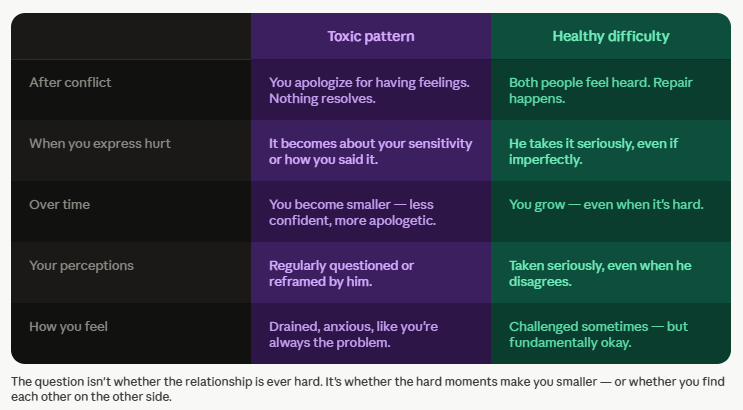
A toxic relationship isn’t just one that’s difficult. All relationships have difficulty. What distinguishes toxicity is the consistency, the intensity, and the damage — the way certain patterns, repeated over time, systematically erode your sense of self, your trust in your own perceptions, and your ability to function outside the relationship.
A relationship is toxic when the harm isn’t incidental — when it’s woven into the structure of how you relate. When conflict doesn’t lead to repair but to you feeling smaller. When love is used as leverage. When you consistently leave interactions feeling worse about yourself than when you entered them.
It exists on a spectrum. Some toxic dynamics are overtly harmful — controlling, contemptuous, isolating. Others are subtler: a thousand small moments where your needs are dismissed, your perceptions are questioned, your voice is treated as an inconvenience. Both do damage. The subtle ones are often harder to name.
“A toxic relationship is defined not by a single moment, but by a pattern — and patterns are exactly what we’re trained not to see when we’re in love.”
Why You Can’t Always See It From the Inside
Before the signs, it’s worth sitting with this: the difficulty of seeing a toxic relationship clearly when you’re in it is not a weakness. It’s the result of several very powerful forces working against your vision.
The good moments are real. Toxic relationships are rarely all bad — and if they were, they’d be much easier to leave. The warmth, the laughter, the tenderness — these exist alongside the harm. And the good moments don’t cancel the bad ones, but they make the bad ones feel like exceptions rather than patterns.
Love changes what you’re willing to explain away. When you love someone, you interpret their behavior charitably. You find reasons. You extend grace. This is a beautiful impulse — until it becomes the mechanism by which harm stays invisible.
Intermittent reinforcement keeps you hooked. When warmth and withdrawal alternate unpredictably, the nervous system becomes focused on regaining the warmth. The unpredictability itself creates attachment — the same psychological mechanism behind slot machines. You’re not weak for responding to it. You’re human.
Your self-perception shifts slowly. One of the most insidious features of toxic relationships is that they change how you see yourself gradually enough that you don’t notice. What starts as “he said something hurtful” becomes “I’m too sensitive.” What starts as “that wasn’t okay” becomes “maybe I’m the problem.” By the time the self-doubt is deep, it feels like your own voice.
The Signs Worth Knowing
These aren’t a checklist to run through mechanically. They’re patterns to sit with honestly — and to ask yourself whether they’re consistent, not just occasional.
You feel worse about yourself than you did before this relationship.
Not in the normal way that vulnerability makes you feel exposed — but in a deeper way. You’re more uncertain, more apologetic, more convinced of your own inadequacy. His presence has made you smaller, not larger.
You walk on eggshells.
You monitor his mood before you speak. You calibrate what you can and can’t say. You feel a low-level anxiety in his presence that you’ve started to accept as normal.
Your feelings are regularly dismissed or turned against you.
When you express hurt, the conversation becomes about your sensitivity. When you raise a concern, it becomes evidence of your irrationality. You end up apologizing for having feelings that were legitimate.
You feel isolated from the people who know you.
Whether through his direct discouragement or through the quiet shame of not wanting to explain things, you’ve pulled away from friends and family. His world has become your world.
Conflict doesn’t resolve — it cycles.
Arguments don’t end with understanding. They end with you backing down, or with him storming off, or with a warmth so intense that the original issue disappears without ever being addressed.
You’re constantly trying to figure out what you did wrong.
Not occasionally, after a genuine mistake — but as a default state. You replay conversations, looking for the moment you caused the problem. The relationship has made you the variable.
You don’t recognize yourself.
You’ve changed — your confidence, your friendships, your sense of humor, your willingness to take up space. And not in ways that feel like growth.
The Gradual Nature of It
One of the most consistent features of toxic dynamics is how slowly they develop. Rarely does someone treat you badly from the start — early toxicity would be obvious, and you’d leave. Instead, the pattern builds.
A comment that stings, explained away. A moment of control, softened by apology and tenderness. A boundary crossed once, then again, then so often it stops feeling like a crossing. Each step is small enough to seem like an aberration. Together, they’ve moved you somewhere you never meant to go.
This is why looking back, from a distance, the picture is often so much clearer than it was inside the experience. It’s not that you missed something obvious. It’s that the obvious only becomes visible in hindsight, when you’re no longer inside the gradual accumulation of it.

The Role Your History Plays
It’s also worth naming this: people who grew up in environments where certain dynamics were normalized often don’t recognize those same dynamics as harmful in adulthood. Not because they’re damaged — but because familiarity reads as safety to the nervous system.
If love in your family involved unpredictability, criticism, or conditional warmth, a relationship with those features can feel like home. Not good — but familiar. And familiar, as the nervous system understands it, is often safer than unknown.
This doesn’t mean your past determines your future. But it does mean that recognizing toxicity sometimes requires more than just looking at the present relationship. It requires honesty about what you’ve learned to accept as normal.
You can explore how early patterns shape adult relationships in How to Become Secure in Love When You Never Felt Safe Enough to Try.
What to Do With What You’re Seeing
If you’re reading this and something is resonating — sit with it. You don’t have to make a dramatic decision today.
Trust your body first. Before your mind starts explaining things away, notice what your body knows. The tightness before you see him. The relief when he’s gone. The anxiety that lives in you now that didn’t used to.
Document what happens. Not to build a case — but because gaslighting and self-doubt make memory unreliable. Keeping private notes about what actually happened helps you trust your own perceptions when someone else is working against them.
Talk to someone outside the relationship. A friend, a therapist, someone who knew you before. Not to be told what to do — but because your perspective from inside is limited, and an outside view can reflect things back that you can no longer see clearly.
Give yourself permission to take what you’re feeling seriously. The fact that there are good moments doesn’t erase the pattern. The fact that he has pain or struggles doesn’t make the harm to you acceptable. Both things can be true — and they don’t cancel each other out.
If you’ve been wondering whether what you’re experiencing crosses into emotional unavailability, Why Do I Feel Alone in My Relationship? The Real Signs of Emotional Unavailability explores those patterns in depth.
A Word About Leaving
Leaving a toxic relationship is not simple, and this article isn’t going to pretend it is. Love is real even when it’s harmful. History is real. Fear is real. The hope that things will change is real — and not irrational, because sometimes they do.
What this article can offer is this: awareness is where everything begins. Seeing the pattern clearly — without minimizing it, without explaining it away — is the first act of self-respect. What you do with that clarity is yours to decide, ideally with support.
You don’t have to have it all figured out to start trusting what you see.
Journaling Prompts
- Who were you — what did you think of yourself, how did you move through the world — before this relationship? What’s different now, and what do you make of that difference?
- Is there something you’ve explained away or minimized that, if a close friend described it to you, you would recognize as a problem? What’s made it hard to extend yourself the same recognition?
- What would it mean to take your own perceptions seriously — fully, without immediately looking for the alternative explanation?
Frequently Asked Questions About Toxic Relationships
How do I know if my relationship is toxic or just going through a rough patch?
The key is the pattern, not the moment. All relationships have hard periods. What distinguishes toxicity is the consistency of harm — patterns that don’t improve over time, that leave you feeling smaller rather than occasionally hurt, and where repair either doesn’t happen or happens only to repeat the cycle.
Can a toxic relationship become healthy?
Sometimes — but only with genuine change from both people, usually with professional support, and only if the dynamic hasn’t caused irreparable damage to trust and self-worth. The key indicator isn’t willingness or apology — it’s whether the behavior actually changes and stays changed over time.
Why do I keep making excuses for him?
Because you love him, because the good moments are real, and because the harm has developed gradually enough that each piece seems explainable in isolation. This is how these dynamics work — not because you’re naive, but because love and incremental harm create a very specific kind of blindness.
Am I the toxic one?
The fact that you’re asking this question is itself meaningful. People who cause harm in relationships rarely wonder if they’re the problem — they tend to be certain they aren’t. Genuine self-reflection is a sign of self-awareness, not toxicity. That said, it’s worth examining your own patterns honestly, ideally with a therapist who can give you a clearer perspective than you can give yourself.
What if I’m not sure whether to stay or leave?
You don’t have to decide right now. What matters in this moment is that you see clearly — that you stop minimizing what you’ve experienced and start taking your own perceptions seriously. Clarity comes before decisions. Give yourself permission to arrive at clarity first.
I share more thoughts on love, attachment, and growth over on Pinterest — come find me there.
With love – Zsana