There’s a particular kind of loneliness that only married people know.
It’s not the loneliness of being alone. It’s the loneliness of being next to someone — every day, in the same bed, at the same table — and still feeling like the distance between you is enormous.
You’re not fighting. You’re not in crisis. You’re just… not really connected anymore. And sometimes that quiet disconnection is harder to name than an actual problem, because there’s nothing obvious to point to.
What’s missing, in most cases, is emotional intimacy. And understanding what that means — and how to rebuild it — can change everything about how a marriage feels.
What Emotional Intimacy Actually Is
Emotional intimacy is the felt sense of being truly known by your partner — and knowing them in return.
It’s not about grand declarations of love. It’s not about how much time you spend together or how good your communication is on practical matters. It’s something more specific: the experience of being seen, understood, and accepted at the level of your inner world.
When emotional intimacy is present, you can say what you actually feel — not the edited, socially acceptable version. You can be afraid, uncertain, disappointed, or struggling, and trust that it won’t be dismissed or used against you. You can share something vulnerable and feel met by it, not managed.
When it’s absent, the opposite happens. Conversations stay on the surface. You talk about schedules, logistics, the kids, work. The deeper stuff — what you’re hoping for, what you’re worried about, what you need — stays unspoken, because somewhere along the way it stopped feeling safe to say.
“Emotional intimacy isn’t built in the big moments. It’s built in the thousand small ones where you chose to stay present instead of pulling away.”
How Emotional Intimacy Fades in Marriage
It rarely disappears overnight. It drifts.
Life takes over — careers, children, responsibilities, exhaustion. Conversations that used to be about each other become about everything else. The emotional check-ins that happened naturally in the early years start to feel like extra effort neither of you has energy for.
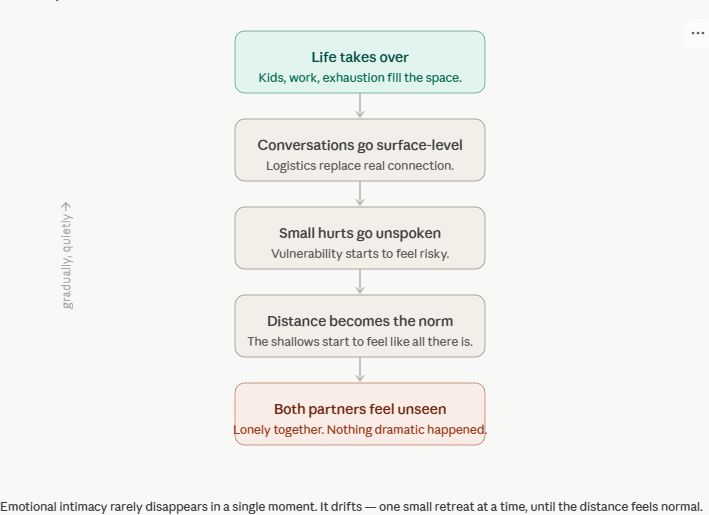
Small disconnections accumulate. He says something dismissive when you were hoping for understanding. You withdraw instead of saying what you need. A pattern develops — not maliciously, just gradually — where depth feels like more work than either of you can manage right now.
There’s often also the issue of conflict avoidance. Many couples stop going deep because depth leads to difficult territory — old hurts, unresolved tension, conversations that feel too big to have after a long day. So the relationship stays in the shallows. And shallows, over time, start to feel like all there is.
If this resonates, When You’re Lonely in Your Own Marriage: Understanding Emotional Distance explores what that experience really looks like from the inside.
Signs Emotional Intimacy Has Faded
Sometimes it’s obvious. Often it’s not. Here are some signs worth paying attention to:
- Conversations stay practical. You talk about what needs to get done, not how either of you is really doing.
- You feel more like roommates than partners. The warmth is still there, but the sense of being chosen — of mattering to each other beyond logistics — has dulled.
- You stop sharing the small things. Something happens during your day and your first instinct isn’t to tell him.
- Vulnerability feels risky. You’ve learned, somewhere along the way, that certain feelings won’t be received well — so you stopped offering them.
- Sex feels disconnected from emotion. Physical intimacy is still present, but it doesn’t feel like it reaches the deeper layer.
- You feel unseen. He doesn’t know what you’re struggling with right now. And maybe you don’t fully know what’s going on with him either.
None of these are signs of a failed marriage. They’re signs that emotional intimacy has become something that needs active attention — which is true in most long-term relationships at some point.
Why Rebuilding It Feels Hard
If emotional intimacy is so important, why don’t couples simply choose to rebuild it?
Because by the time it’s noticeably absent, there are often layers on top of it.
Resentment, for one. Unspoken hurts that have calcified into distance. A kind of protective guardedness that developed because being open felt unsafe at some point, and nobody explicitly said so.
There’s also the vulnerability problem. Rebuilding emotional intimacy requires both partners to risk being seen again — and that’s uncomfortable when you’ve been in the shallows for a while. The first conversation that goes deeper than usual can feel awkward, exposing, even a little strange.
And there’s the pattern itself. Couples who have been functioning in surface mode for months or years have developed a rhythm. Breaking that rhythm — choosing depth when the habit is logistics — takes deliberate effort that can feel effortful and slightly unnatural at first.
This is where it helps to understand that reconnection doesn’t require a dramatic intervention. It builds from small moments.

How to Rebuild Emotional Intimacy
Rebuilding emotional intimacy is less about what you do and more about how you show up — repeatedly, in small ways, over time.
Start with curiosity.
The simplest and most powerful thing you can do is become genuinely interested in your partner’s inner world again. Not his schedule — his inner world. What’s he worried about right now? What’s he hoping for? What’s been sitting with him lately that he hasn’t said out loud?
And offer the same in return. Share something true, something small but real. Let him see a little more of you than the managed version.
Create space for the harder conversations.
Not the crisis conversations — those have their own weight. The quieter ones. The ones where you say “I’ve been feeling disconnected from you and I miss you” rather than waiting until it becomes an argument.
Those conversations require courage, but they’re also the ones that move the needle most.
Pay attention to bids for connection.
Relationship researcher John Gottman describes “bids” — small moments when one partner reaches for the other emotionally. A comment about something they noticed. A piece of news they want to share. A vulnerable moment offered quietly.
How you respond to these bids — whether you turn toward them or away — is one of the most powerful determinants of emotional intimacy over time. Turning toward doesn’t require much. It just requires being present enough to notice.
Bring back the small rituals.
Emotional intimacy is sustained by daily moments of connection — not weekly date nights. A real conversation over coffee before the day starts. A few minutes at the end of the day where you actually talk, not just debrief. Small consistent rituals that say we prioritize this.
You can find more on this in The Small Habits That Quietly Hold a Marriage Together.
Let yourself be known.
This is the harder side of rebuilding intimacy — because it requires vulnerability, not just effort. Showing up with more of your honest self, rather than the version that’s easier for him to be around. Saying what you need, even when you’re not sure how it will land.
Emotional intimacy is not something one person can build alone. But one person can start.
“You don’t rebuild emotional intimacy in a single conversation. You rebuild it by choosing each other, quietly, in a hundred small moments.”
When to Consider Outside Help
Sometimes the distance has grown too wide for the two of you to bridge alone — and that’s not a failure. That’s a sign that the relationship deserves more support than two people can reasonably provide to each other while they’re also the ones who are hurt.
Couples therapy, done with the right therapist, doesn’t mean your marriage is in crisis. It means you’re taking the connection seriously enough to invest in it. Many couples find that a few sessions help them say things they hadn’t been able to say, and hear each other in ways that had stopped happening.
If your partner is resistant to the idea of therapy, How to Reconnect Emotionally With Your Husband When You Feel Miles Apart offers practical approaches for reaching toward reconnection even when it feels one-sided.
Journaling Prompts
- When did you last feel truly emotionally close to your partner? What was present in that moment — and what’s different now?
- Is there something you’ve been feeling, needing, or thinking about that you haven’t shared with him? What’s made it feel unsafe or not worth bringing up?
- What would it look like to show up with a little more of your honest self in the next week — not in a big way, but in a small, everyday one?
Q&A – About Emotional Intimacy in Marriage
What’s the difference between emotional intimacy and physical intimacy?
Physical intimacy is about closeness at the level of the body. Emotional intimacy is closeness at the level of the inner world — being truly known, understood, and accepted by your partner. The two are connected but distinct. Many couples have one without the other, though research consistently shows that emotional intimacy is a stronger predictor of long-term relationship satisfaction.
Can emotional intimacy be rebuilt after a long period of distance?
Yes — and often more effectively than people expect. The distance usually built gradually, which means it can also close gradually. It rarely requires one big breakthrough; it usually requires consistent small choices to be more present, more honest, and more curious about each other over time.
Why does my husband seem uncomfortable with emotional intimacy?
Many men weren’t taught the language of emotional vulnerability — or were actively taught to suppress it. This doesn’t mean he’s incapable of closeness, but it may mean that depth needs to be approached differently. Starting with lower-stakes conversations, sharing first yourself, and creating safety rather than pressure can help open the door.
Is lack of emotional intimacy a reason to consider divorce?
Not on its own — but it’s a serious signal worth taking seriously. Sustained emotional disconnection erodes the foundation of a marriage over time. If efforts to reconnect aren’t working, couples therapy is worth exploring before making any permanent decisions.
How long does it take to rebuild emotional intimacy?
There’s no fixed timeline. Some couples feel a meaningful shift after a few honest conversations. Others need months of consistent effort and support. The pace matters less than the direction — as long as both partners are moving toward each other, something is rebuilding.
I share more thoughts on love, attachment, and growth over on Pinterest — come find me there.
With love – Zsana