You say yes when you mean no.
You apologize before you’ve even finished a sentence. You scan his mood before you share yours. You bend, adjust, soften, shrink — and you do it so automatically that you barely notice anymore.
It feels like kindness. It feels like keeping things smooth. But underneath the yes is something quieter and more costly: the slow disappearance of yourself.
People-pleasing in relationships is one of the most common — and most invisible — ways women lose themselves in love. And understanding it is the first step to finding your way back.
The Difference Between Kindness and People-Pleasing
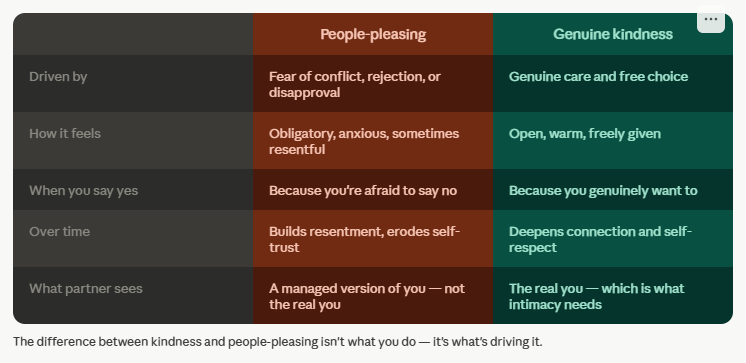
This distinction matters, because people-pleasers are often genuinely kind, warm, generous people. The pattern isn’t about bad intentions.
The difference is this: kindness comes from a place of choice. People-pleasing comes from fear.
When you do something for a partner out of love and genuine generosity, it feels open. When you do it because you’re afraid of what happens if you don’t — afraid of conflict, of disappointing him, of the relationship shifting — that’s people-pleasing. And over time, those two things start to look identical from the outside, while feeling completely different on the inside.
A useful question to sit with: Am I doing this because I want to — or because I’m afraid of what happens if I don’t?
“Every time you said ‘whatever you want’ when you meant something different, you missed a chance to know yourself a little better.”
Where It Comes From
People-pleasing doesn’t appear out of nowhere. It almost always has roots.
For many women, it begins in childhood — in environments where keeping the peace was a survival strategy. Where expressing needs led to conflict, withdrawal, or disapproval. Where being “easy” and “agreeable” was the safest way to maintain love and connection.
Your nervous system learned the lesson early: make others comfortable, and you’ll be okay. That’s not weakness. That’s an extraordinarily intelligent adaptation to an environment that didn’t always feel safe.
The problem is that the strategy that protected you then is now the thing costing you most in your adult relationships. What kept you connected as a child is what’s keeping you hidden as a woman.
People-pleasing is also closely tied to anxious attachment — the deep, underlying fear that if you’re too much, too honest, too yourself, love will be withdrawn.
You can explore that connection more in Anxious Attachment in Relationships: Why You Love So Hard and Fear So Much.
What It Actually Looks Like
People-pleasing in relationships is subtle. It rarely looks like doormat behavior from the outside. It looks like being a good partner.
Here are some of the ways it shows up:
- You apologize reflexively — often before you’re even sure what you did wrong, or when you’re not sorry at all.
- You default to “whatever you want” — not because you don’t have preferences, but because voicing them feels risky.
- You manage his emotions before your own — checking his mood, calibrating what to say, softening your truth to protect his comfort.
- You avoid bringing things up — not because they don’t matter, but because conflict feels dangerous.
- You feel resentment building — quietly, underneath all the accommodation, because you keep giving what you don’t freely offer.
That last one is important. Resentment is one of the clearest signs that people-pleasing is happening. It’s the gap between what you’re giving and what you actually want to give.
What It Does to the Relationship
Here’s the painful irony: people-pleasing is often meant to protect the relationship. But over time, it quietly hollows it out.
When you consistently hide your real preferences, needs, and feelings, your partner never actually gets to know you. He’s in a relationship with the version of you that’s always agreeable, always fine, always adjusting. And that version isn’t fully real.
Real intimacy requires two people showing up authentically. When one person disappears — even kindly, even with good intentions — the connection becomes one-sided. And one-sided relationships, however warm they look on the surface, don’t feel like home.
There’s also the dynamic it can create in him. A partner who never experiences your needs, your limits, or your honest reactions doesn’t have the opportunity to rise to meet them. You inadvertently train the relationship to function without your full self in it.
You can read more about what happens in relationships where one person consistently goes unmet in When Emotional Needs Go Unmet: What It Does to You and How to Reclaim Your Voice.
The Cost to You
Beyond the relationship, there’s what people-pleasing does to you.
When you spend years — or a lifetime — organizing yourself around someone else’s needs, preferences, and emotional states, you don’t just lose track of your own. You stop developing them.
Every time you swallowed an opinion to keep the peace, you missed a chance to know your own values. Every time you performed enthusiasm you didn’t feel, you missed a chance to know your own truth. Over time, those missed moments compound. The self that could have developed — the one with clear preferences, firm limits, and a grounded sense of what’s acceptable — never fully forms.
Many people-pleasers reach a point of exhaustion and don’t know why. They’ve been so focused on what everyone else needs that they’ve genuinely lost touch with what they need. That disconnection — from your own feelings, wants, and instincts — is one of the quietest and most serious costs of this pattern.
“Keeping the peace at the cost of your truth isn’t peace. It’s disappearance.”
How to Begin to Change It
The goal isn’t to become someone who says no to everything, who stops being caring or considerate. The goal is to become someone who gives from genuine choice rather than fear.
That shift doesn’t happen overnight — but it does happen. Here’s where to start.
1. Notice the pause between request and response.
Before you automatically say yes, give yourself a moment. “Let me think about that” is a complete sentence. That small pause is where your actual answer lives.
2. Ask yourself the honest question.
Am I doing this out of genuine generosity, or because I’m afraid of what will happen if I don’t? You don’t have to solve it in that moment — just noticing is powerful.
3. Start with small truths.
You don’t have to begin with the big, vulnerable conversations. Start with the small ones. Voice a preference about where to eat. Share a reaction honestly instead of smoothing it over. Build the muscle in low-stakes moments.
4. Let discomfort be information, not a stop sign.
The first time you say something honest that he doesn’t love, it will feel awful. That’s not evidence you did something wrong. Discomfort is a sign that something is shifting — and healthy relationships can hold friction without breaking.
5. Reconnect with your own needs.
What do you actually want? Not as a partner, not in relation to him — but for yourself? If that question feels hard to answer, that’s important information. Reconnecting with your own preferences, values, and desires is the foundation of everything else.
If you’ve been struggling with reassurance-seeking alongside people-pleasing, How to Stop Seeking Constant Reassurance and Trust Yourself Again is worth reading alongside this.
A Note on What Happens When You Stop
When you begin to change this pattern, something uncomfortable tends to happen: some people won’t like it.
A partner who was comfortable with your endless accommodation may feel thrown off when you start having opinions. People who relied on you being “the easy one” will push back. You may even be called selfish — for having needs you’ve always had but never expressed.
This is not a sign you’re doing it wrong. It’s a sign that the dynamic is shifting. The people who genuinely love you — not the performance of you, but you — will lean in as you become more yourself. Let that be the compass.
Journaling Prompts
- Think of a recent moment when you said yes and meant no. What were you afraid would happen if you’d been honest?
- What messages did you receive growing up about what happened when you expressed your own needs or disagreed with someone close to you?
- If you knew that the people who truly loved you could handle your honesty — what would you say, or ask for, that you’ve been holding back?
Q&A – About People-Pleasing in Relationships
Is people-pleasing the same as being a good, caring partner?
There’s an important difference. Genuine care and generosity come from a free place — you give because you want to. People-pleasing is driven by fear of conflict, rejection, or disapproval. From the outside they can look identical, but they feel very different on the inside — and over time, people-pleasing leads to resentment and disconnection.
Can people-pleasing actually damage a relationship?
Yes — even when it looks like harmony on the surface. When one partner consistently hides their real needs and feelings, the other never truly knows them. Real intimacy requires two people showing up authentically. A relationship built on one person’s constant accommodation isn’t really connection — it’s a performance.
Where does people-pleasing come from?
Most often, early experiences where keeping the peace felt necessary for safety or love. If expressing needs as a child led to conflict, withdrawal, or disapproval, the nervous system learns to prioritize others’ comfort over your own truth. It’s a survival strategy — one that no longer serves you as an adult.
Is people-pleasing linked to anxiety or attachment style?
Yes. It’s most commonly associated with anxious attachment — the underlying fear that being too honest, too needy, or too “difficult” will cost you love. The people-pleasing behavior is an attempt to manage that fear by making yourself as agreeable as possible.
How do I stop people-pleasing without damaging my relationship?
Gradually, and with self-compassion. Start with small truths in low-stakes moments. Build tolerance for the discomfort of being honest. Remember that a healthy relationship can hold friction — and that your partner deserves to know the real you, not a carefully managed version.
I share more thoughts on love, attachment, and growth over on Pinterest — come find me there.
With love – Zsana