You’ve probably read about secure attachment.
You know it’s the “healthy” one. The one everyone is supposedly working toward. The one that shows up in therapy sessions and attachment style quizzes as the gold standard.
But knowing the label and actually recognizing it in real life — in the ordinary, imperfect texture of a relationship — are two very different things.
Secure attachment doesn’t look like perfection. It doesn’t mean no conflict, no hard moments, no fear. It looks quieter than that. Steadier. More like a quality of safety you stop noticing because it’s always there.
This is what it actually looks like.
The Feeling Underneath Everything
The most defining feature of secure attachment isn’t a behavior. It’s a feeling.
It’s the feeling that the relationship can hold you — all of you. Your needs, your fears, your bad days, your honest reactions. Not because everything is always fine, but because there’s a fundamental sense that you are safe here. That expressing yourself won’t cost you the relationship.
For women who have experienced anxious or avoidant patterns, this can feel disorienting at first. The absence of anxiety can feel strange. The lack of push-pull can feel like something is missing. That disorientation is worth naming — because it’s often why securely attached relationships feel “boring” to people who’ve only known intensity.
What reads as boring is actually safety. And safety, it turns out, is the foundation everything else is built on.
“Secure love doesn’t feel like a rollercoaster. It feels like solid ground — and once you’ve had it, you realize how exhausted you were before.”
What It Looks Like Day to Day
Secure attachment isn’t a grand gesture. It lives in the ordinary moments — in how you and your partner navigate the small things, again and again.
Here’s what it tends to look like in practice:
- You can express a need without rehearsing it first. You don’t spend twenty minutes figuring out how to word something so he won’t react badly. You just say it.
- Conflict doesn’t feel like a threat. When disagreements happen, neither of you interprets them as evidence that the relationship is failing. You can be upset with each other and still feel fundamentally okay.
- He’s curious about you — consistently. Not just in the beginning. A securely attached partner stays genuinely interested in who you are, what you’re thinking, what matters to you.
- Space doesn’t create panic. Time apart, different moods, a quiet evening where you’re both in your own world — none of this sets off an alarm. There’s enough trust to hold the distance.
- Repair happens. After conflict or disconnection, you come back together. Not because one person manages it all, but because both people want to.
None of these are dramatic. That’s the point. Secure attachment is built from hundreds of small, consistent moments — not from grand romantic gestures.
How Conflict Works in a Secure Relationship
Conflict is one of the clearest windows into attachment — because it’s where most people’s patterns show up most visibly.
In anxious attachment, conflict activates fear of abandonment. The urge is to chase, to fix, to make the discomfort stop at any cost. In avoidant attachment, conflict activates the need for distance. The instinct is to shut down, go quiet, and wait it out alone.
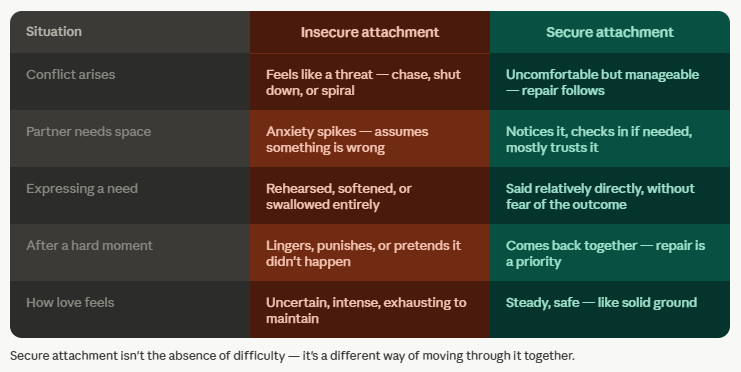
In secure attachment, conflict is uncomfortable — but it isn’t catastrophic.
A securely attached partner can hear that you’re upset without becoming defensive or disappearing. They can disagree without making you feel like the relationship is on the line. They can be wrong and acknowledge it. They can be hurt and say so directly, without punishing you for it.
And crucially — they repair. Not perfectly, not always immediately. But consistently.
You can read more about what healthy conflict patterns look like in How Secure Women Handle Conflict in Marriage (And What You Can Learn From Them).
What Secure Attachment Feels Like After Anxious or Avoidant Relationships
If you’ve come from relationships marked by inconsistency, emotional unavailability, or the exhausting push-pull of anxious dynamics, a secure relationship can feel genuinely confusing at first.
You might find yourself waiting for the other shoe to drop. Scanning for signs that the warmth will disappear. Feeling unsettled by the steadiness, because steadiness isn’t what you learned to expect from love.
This is one of the most important things to understand: your nervous system was calibrated by your past experiences. If love always felt uncertain, then certainty can actually feel unfamiliar — even wrong.
That disorientation doesn’t mean the relationship isn’t right. It often means it’s the healthiest thing you’ve been in.
“When love finally feels safe, the first response is often not relief. It’s suspicion. Your nervous system doesn’t know what to do with peace.”
The Four Foundations of Secure Attachment
Research on secure attachment points to four consistent elements — sometimes called the “4 S’s” — that create the conditions for security in a relationship.
Seen. You feel genuinely known by your partner. Not just the surface version of you — but your fears, your history, your contradictions. He pays attention and stays curious.
Safe. You feel protected from harm — emotional as well as physical. You’re not walking on eggshells. You’re not managing his reactions before you speak.
Soothed. When you’re distressed, he can be a source of comfort. He doesn’t fix, dismiss, or disappear. He stays.
Secure. The relationship itself feels like a stable base — something you can return to, rest in, and launch from. It doesn’t require constant maintenance to feel real.
These four things aren’t about perfection in a partner. They’re about a consistent pattern of care, presence, and repair over time.

Can You Become Securely Attached?
Yes — and this might be the most hopeful thing in all of attachment theory.
Secure attachment isn’t only something you either had in childhood or didn’t. Research shows that adults can develop what’s sometimes called “earned security” — a genuine shift toward secure attachment patterns through supportive relationships, therapy, and sustained self-awareness.
What changes isn’t the past. It’s your relationship to it. People who develop earned security don’t erase their histories — they make sense of them. They can hold their experiences with understanding and compassion rather than shame or confusion.
This means that even if your early experiences didn’t give you a secure foundation, you are not fixed in place. The nervous system can learn. The patterns can shift. It takes time and often support — but it happens.
You can explore what that process looks like in How to Become Secure in Love When You Never Felt Safe Enough to Try.
Signs You’re Moving Toward Secure Attachment
You don’t have to be in a perfectly secure relationship to be moving in the right direction. Here are some signs that your own patterns are shifting:
- You can express a need and then let go of the outcome, rather than spiraling about how it will land.
- You notice anxiety or old patterns activating — and you don’t immediately act on them.
- Conflict feels uncomfortable, but no longer existential.
- You can tolerate distance or uncertainty without it consuming your attention.
- You’re starting to trust your own perceptions again — to let your gut feelings be information rather than something to explain away.
These shifts don’t happen all at once. They accumulate, quietly, over time.
Journaling Prompts
- Think of a relationship — romantic or otherwise — where you felt genuinely safe to be yourself. What was present in that dynamic that allowed you to feel that way?
- When you imagine a relationship where conflict doesn’t feel like a threat, what comes up? Does it sound appealing, or does some part of you feel skeptical? What does that tell you?
- What would it mean for you — specifically — to feel “seen” in a relationship? What would your partner need to know, or do, for that to feel real?
Q&A – About Secure Attachment
Can you become securely attached if you weren’t raised that way?
Yes. Research on “earned secure attachment” shows that adults can genuinely develop secure patterns through supportive relationships, therapy, and self-reflection — even without a secure childhood foundation. Attachment styles are not fixed traits; they’re learned patterns that can shift.
Does secure attachment mean never feeling anxious in a relationship?
No. Securely attached people still feel anxiety, fear, and uncertainty — they’re human. The difference is that these feelings don’t take over. They can be felt, named, and managed without driving destructive behavior or creating relationship chaos.
How do I know if my partner is securely attached?
Watch how he handles conflict, disconnection, and your emotional needs over time. A securely attached partner repairs after arguments, stays curious about you, can hear your needs without becoming defensive, and doesn’t use distance or silence as punishment.
Is it possible to be secure in one relationship and insecure in another?
Yes. Attachment isn’t purely fixed — it’s also relational. Someone who tends toward anxious attachment may feel more secure with a particularly steady, patient partner. A secure person may find old insecure patterns activated by a highly avoidant partner. Context matters.
What’s the difference between secure attachment and just being “comfortable”?
Comfort in a relationship can sometimes be complacency — a kind of settling into the familiar. Secure attachment is different: it involves ongoing emotional presence, genuine curiosity, and the ability to navigate difficulty together. Comfort without growth or connection isn’t the same thing.
I share more thoughts on love, attachment, and growth over on Pinterest — come find me there.
With love – Zsana