You know the moment.
You try to bring something up — something that matters, something you’ve been carrying — and you watch him close. The eye contact disappears. The responses become one word, or nothing at all. He might leave the room. He might stay physically present but go somewhere you can’t reach.
And you’re left there, mid-sentence, feeling more alone than if you’d never said anything at all.
This is stonewalling. And it’s one of the most painful — and most misunderstood — dynamics in marriage. Not because it’s always cruel, but because it can look like indifference when it’s actually something much more complicated.
What’s Actually Happening When He Shuts Down
The first thing worth understanding is this: most of the time, stonewalling isn’t a deliberate act of punishment. It’s a response to being overwhelmed.
Relationship researcher John Gottman calls it “flooding” — a state of physiological overwhelm where the nervous system is so activated that the person literally cannot process or respond effectively. Heart rate spikes. Stress hormones flood the body. The capacity for calm, rational conversation disappears.
For many men, emotional conflict triggers this flooded state faster and more intensely than it does for women. Research from Gottman’s Love Lab found that 85% of stonewallers in relationships are men — not because men are more flawed, but because of how many men were socialized to relate to emotional intensity. When things get emotionally charged, the nervous system sounds the alarm: shut down, get out, wait for it to pass.
That doesn’t make it okay. But it does change what’s actually happening — and what’s likely to help.
“He’s not shutting you out because you don’t matter. He’s shutting down because he doesn’t know how to stay.”
What It Feels Like on Your Side
Even knowing this, the experience of being stonewalled is genuinely painful.
When someone you love goes silent in response to your reaching, the nervous system reads it as rejection. As abandonment. You push harder — which triggers more flooding in him — which causes more shutdown — which makes you feel more desperate for a response. It’s a cycle that escalates quickly, and both of you end up worse off than when you started.
Many women in this dynamic begin to doubt themselves. Am I too intense? Am I asking too much? Why can’t we just talk like normal people?
The self-doubt is a natural response to a pattern where your reaching consistently produces withdrawal. It’s not evidence that you’re the problem.
The Cycle That Makes It Worse
Understanding the pursuer-withdrawer cycle is one of the most useful things you can do in this dynamic.
One partner — often, but not always, the woman — pursues connection during conflict. She wants to talk, to resolve, to feel close again. The other partner withdraws, overwhelmed by the emotional intensity. The pursuer pursues harder. The withdrawer withdraws further. Both feel misunderstood and alone.
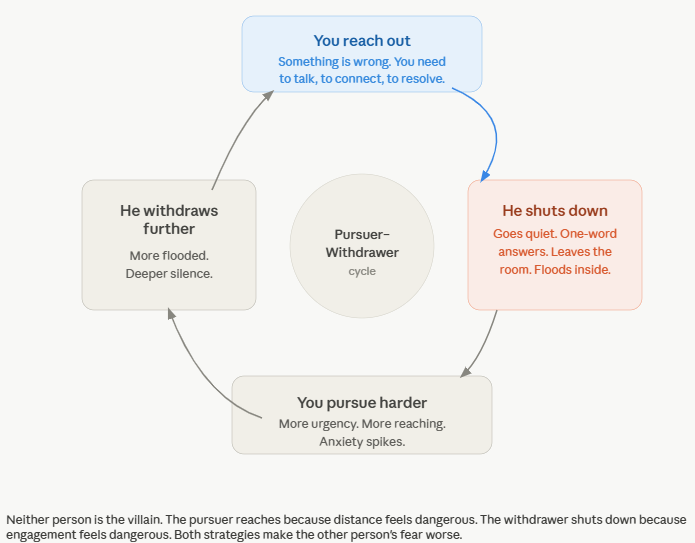
Neither person is villainous here. The pursuer is trying to maintain connection. The withdrawer is trying to regulate an overwhelming internal state. But the strategies collide — and without awareness of the dynamic, both people stay stuck in it.
Breaking the cycle requires something counterintuitive: stopping.
How to Reach Him Without Making It Worse
1. Don’t pursue when he’s flooded.
This is the hardest part, especially when you need resolution. But continuing to push when he’s in a flooded state will not produce connection — it will produce more shutdown. The conversation you want to have cannot happen in that moment. Letting it pause isn’t giving up. It’s creating the conditions where a real conversation becomes possible.
2. Agree on a signal — before you need one.
Gottman research recommends couples agree in advance on a way to call for a break — a word, a phrase, a gesture — that both partners recognize and honor. This gives him a way to exit without it feeling like abandonment, and gives you certainty that the conversation will return. The break should have a time limit — “let’s come back to this in 30 minutes” — so it doesn’t become indefinite avoidance.
3. Change how you open the conversation.
Gottman also identifies what he calls a “harsh startup” as one of the strongest predictors of a conversation going badly. If the opening is accusatory, critical, or emotionally charged, flooding happens faster. A softer startup — “I’ve been feeling disconnected and I’d love to talk when you have capacity” rather than “You never talk to me” — creates a different physiological environment to start from.

4. Name what you need, not what he’s doing wrong.
“I feel scared when you go quiet because I don’t know where we stand” lands differently than “You always shut down on me.” The first is about your experience. The second is an attack that his nervous system will respond to defensively. Neither approach guarantees a perfect response — but one creates more room for him to actually hear you.
5. Find a lower-intensity moment.
Many couples make the mistake of trying to have important conversations in the middle of conflict, when both nervous systems are already activated. Raising something that matters to you during a calm moment — on a walk, in the car, not right after a hard day — gives you both a better starting place.
You can read more about the kinds of conversations that change everything in The Conversations Most Couples Are Afraid to Have (And Why They Change Everything).
When It’s More Than Just Flooding
It’s important to name this: not all emotional withdrawal is the same.
There’s the shutdown that comes from being overwhelmed — physiological, protective, and not about you. And then there’s the shutdown that’s chronic, punitive, and used as a way to control or avoid accountability. The silent treatment used deliberately, for days at a time, to punish or destabilize — that’s something different.
If his withdrawal is consistent, if repair never happens, if bringing things up always ends in you apologizing for having brought them up — that’s worth paying close attention to. The approaches here are designed for the first kind of shutdown. Chronic emotional unavailability that shows no movement over time deserves more than communication strategies.
For more on recognizing the difference, Why Do I Feel Alone in My Relationship? The Real Signs of Emotional Unavailability is worth reading alongside this.
What Repair Actually Looks Like
One of the things that gets overlooked in conversations about stonewalling is what happens after. The shutdown itself is painful — but the absence of repair is often what does the most damage long-term.
Repair doesn’t have to be a formal conversation. It can be small. A hand on the shoulder. “I’m sorry I went quiet — I got overwhelmed.” A few words that say: I know what happened, and I’m still here. These gestures matter more than most people realize. They signal that the disconnection was temporary, not a verdict. That the relationship is bigger than the moment.
If repair consistently doesn’t happen — if every shutdown is followed by a return to normal as if nothing occurred — that absence accumulates. Unacknowledged disconnections don’t disappear. They become part of the foundation, quietly shaping how safe it feels to reach for each other the next time.
If you find that repair is hard to initiate, How to Reconnect Emotionally With Your Husband When You Feel Miles Apart offers gentle, practical ways to bridge back toward each other after distance.
What You Can Do for Yourself in the Meantime
While you’re working on the dynamic between you, there’s also the question of how you hold yourself through it.
When he shuts down, your nervous system activates. The urge to chase, to fix, to make the silence stop is real and urgent. Learning to self-regulate in those moments — to ride out the discomfort without escalating — is one of the most valuable things you can build.
This doesn’t mean suppressing what you feel. It means giving yourself a few minutes before responding. Noticing the activation in your body. Reminding yourself that his shutdown is about his capacity in this moment, not a verdict on your worth.
The steadier you can stay, the more space there is for something different to happen between you.
Journaling Prompts
- When he shuts down, what’s the story you tell yourself about what it means? Where do you think that story comes from?
- What do you most need him to understand about how his withdrawal affects you — and have you ever said it clearly, outside of a moment of conflict?
- What would it look like to respond differently the next time he goes quiet — not to give up, but to create space for the conversation to actually happen?
Q&A – About Stonewalling in Marriage
Is stonewalling the same as the silent treatment?
They overlap but aren’t identical. The silent treatment is usually deliberate — used to punish or control. Stonewalling is often involuntary — a physiological response to emotional overwhelm. Both feel painful to be on the receiving end of, but they have different causes and call for different responses.
Why do men stonewall more than women?
Research suggests men tend to become physiologically flooded more quickly during emotional conflict, and many men were socialized to avoid or suppress emotional expression. This doesn’t make stonewalling acceptable — but it does explain why it’s more common in men and why emotional overwhelm is usually at the root.
How long should I give him before coming back to the conversation?
At least 20–30 minutes, according to Gottman research — that’s roughly how long it takes for the nervous system to return to baseline after flooding. Coming back sooner often means one or both partners are still activated and the conversation goes sideways again.
What if he uses taking space as a way to never address things?
This is a real and important distinction. A break that leads to repair is healthy. A break that becomes indefinite avoidance — where nothing is ever resolved and bringing it up again is met with more shutdown — is a pattern worth addressing directly, possibly with the support of a couples therapist.
Can stonewalling damage a marriage long-term?
Yes. Gottman identifies it as one of the four strongest predictors of relationship breakdown. When one partner consistently shuts down and repair never happens, the other partner eventually stops reaching — and that emotional withdrawal on both sides can quietly end a marriage without either person making an explicit decision.
I share more thoughts on love, attachment, and growth over on Pinterest — come find me there.
With love – Zsana