He talked about the house you’d live in one day.
The trips you’d take. The life you’d build together. He described it all so vividly — the porch, the dog, the Sunday mornings that felt like a promise. And you believed him. Of course you did. Why would someone say those things if they didn’t mean them?
But months passed. Then years. And none of it came.
The future stayed exactly where it always was — somewhere in the distance, just out of reach, always almost happening but never actually here.
If this sounds familiar, you may have experienced something called future faking. It’s one of the more quietly painful patterns in relationships, because it doesn’t feel like betrayal at first. It feels like hope.
What Future Faking Actually Is
Future faking is when someone uses promises about the future to create emotional connection, manage conflict, or keep you invested — without any real intention of following through.
It’s not always calculated or malicious. Sometimes it comes from a place of avoidance. The person making promises genuinely doesn’t want conflict or disconnection in the present moment, so they offer the future as a kind of emotional pacifier.
But the impact is the same either way.
You end up organizing your feelings, your patience, and sometimes your entire life around a version of the relationship that never materializes.
“He wasn’t lying about the future. He was lying about who he was in the present.”
Why It’s So Hard to Recognize
One of the most disorienting things about future faking is how real it feels when it’s happening.
He wasn’t cold. He wasn’t distant. He was warm, engaged, enthusiastic. He could describe your future life together in detail that felt almost cinematic. And that kind of specificity reads as sincerity.
We’re wired to trust people who seem excited about us. When someone paints a picture of the future with you in it — vacations, a home, a family, a life — your nervous system registers it as evidence of commitment. It lowers your guard. It deepens the bond.
The problem is that words about the future require nothing in the present. They cost nothing emotionally. They can be offered freely, repeatedly, and completely disconnected from any actual action.
It often takes a long time to notice the pattern, because there’s always a reason why this particular thing didn’t happen. The timing wasn’t right. He got overwhelmed. He meant it, he just needs more time. And because you love him, you extend grace. Again and again and again.
Related post: Why Getting Closer Makes Some Men Run — And What That Tells You
The Signs You Were Being Future Faked
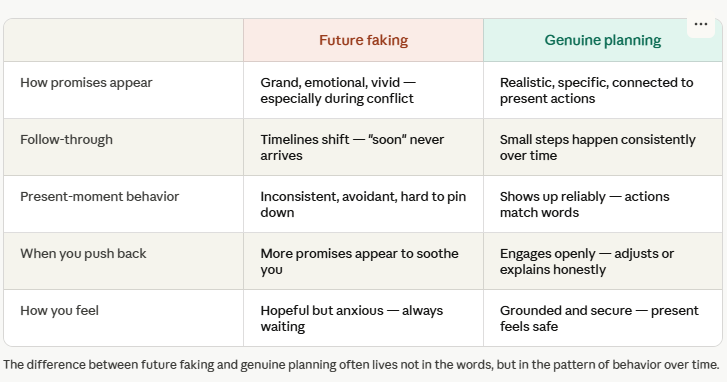
Looking back, the signs are often clearer than they felt in the moment. Here are some of the most common patterns:
- Big promises, small follow-through. He talked about the future in sweeping, loving terms but couldn’t commit to even small things — weekend plans, a dinner reservation, a conversation he kept putting off.
- Promises appeared during conflict. The future talk tended to show up when things got tense. When you expressed disappointment or distance, suddenly the future was on the table again.
- The timeline always shifted. “After the busy season.” “Once things settle down.” “By the end of the year.” The goalposts moved, but the framing stayed warm and loving.
- His present behavior didn’t match his future words. He talked about building a life with you, but he wasn’t showing up consistently. The actions and the words existed in two different realities.
- You felt more secure in the future than in the present. If the future felt safer and more solid than today, that imbalance is worth paying attention to.
What’s Really Going On Underneath
Future faking rarely exists in a vacuum. It tends to be rooted in one of a few deeper dynamics.
Avoidant attachment is one of the most common. People with avoidant patterns often genuinely struggle to be present and emotionally available in the now. The future feels safer to talk about precisely because it’s abstract. It doesn’t require vulnerability today.
Fear of conflict or abandonment is another driver. If someone is deeply uncomfortable with a partner’s disappointment or anger, promising the future becomes a way to soothe the present moment without actually addressing what’s wrong.
And sometimes — it’s manipulation. Not always conscious or intentional, but a learned behavior that keeps a partner invested without requiring genuine reciprocity. If the future is always just around the corner, you never quite reach the point where you leave.
“Hope is not a relationship. It’s a holding pattern.”
How It Affects You
The emotional toll of future faking tends to accumulate slowly, which makes it harder to name.
You might find yourself becoming increasingly anxious, second-guessing your perceptions, or feeling like you’re always waiting for life to actually begin. You start making excuses for him — to your friends, to your family, and most painfully, to yourself.
The longer it goes on, the more you may start to question your own judgment. Was I too demanding? Did I misunderstand? Did I want too much?
You didn’t.
What happened is that someone repeatedly offered you something they weren’t willing or able to deliver. And your heart — because it’s loving and hopeful and invested — kept believing it was right around the corner.
What You Can Do With This Now
Whether you’re still in this relationship or looking back on one, there are some genuinely helpful ways to orient yourself.
1. Start measuring actions, not words.
What does he actually do, consistently, over time? Not what he says he’ll do. Not what he intends. What shows up reliably in the present? That’s your most accurate data.
2. Notice the pattern, not just the individual promise.
One broken promise can be a bad week. A consistent pattern of promises that never materialize is information about the relationship itself. Let yourself see the full picture.
3. Ask directly — and watch how he responds.
Not accusingly, but clearly: “I’ve noticed we’ve talked about X several times but nothing has moved forward. Can we talk about where you actually are on this?” His response — whether it’s defensive, dismissive, or genuinely engaged — will tell you a lot.
4. Reconnect with your own timeline.
What do you need? What are your non-negotiables? Future faking often works because it keeps you oriented toward his future and away from your own. Coming back to your own values and boundaries is an act of self-respect.
5. Give yourself permission to grieve what didn’t happen.
The grief isn’t just about the relationship. It’s about the future you believed in. That loss is real, even if the future was never real. You’re allowed to mourn it.
Related post: The Difference Between a Partner Who Cares and One Who’s Present
A Word About Healing
If you’ve been future faked, you may carry some version of the question: How did I not see it sooner?
The honest answer is that you weren’t naive. You were human. You responded to warmth and specificity the way any feeling person would. You believed someone because they seemed to believe it themselves.
Healing from this kind of relationship often means slowly rebuilding your trust in your own perceptions. It means learning to value present-tense consistency over future-tense eloquence. It means recognizing that someone who loves you — really loves you — shows up in the present. Not just someday.
The future is where he kept you. The present is where love actually lives.
Journaling Prompts
- Looking back, what were the moments when his actions didn’t match his words — and what did you tell yourself to explain the gap?
- How did waiting for the future he described affect your sense of self, your other relationships, or the choices you made in your own life?
- What would it feel like to make decisions based entirely on what someone shows you today, rather than what they promise for tomorrow?
Q&A – About Future Faking
Is future faking always intentional?
Not always. Some people make grand promises with genuine enthusiasm in the moment but lack the self-regulation to follow through. Whether it’s intentional or not, the impact on you is the same — and the pattern matters more than the intent.
Can someone who future fakes actually change?
Change is possible, but it requires consistent action over time — not just apologies or new promises. If his behavior stays the same while his words keep shifting, that’s your answer.
How is future faking different from just being an optimist?
An optimist still takes small, real steps toward the things he talks about. Future faking is marked by a persistent gap between the vision and the action — and promises that tend to appear precisely when you’re pulling away.
Why did I stay so long if nothing was changing?
Because you were given just enough hope to keep believing. That’s not a flaw in your judgment — it’s how this pattern works. You loved someone and you wanted it to be real.
Could I be future faking in my own relationships?
Worth asking honestly: do you make promises to calm a partner down, then struggle to follow through? If there’s a gap between what you say and what you do, that’s worth exploring — with curiosity, not self-judgment.
Related post: When Emotional Needs Go Unmet: What It Does to You and How to Reclaim Your Voice
A Closing Thought
You didn’t fall in love with a lie. You fell in love with a possibility — and that’s a deeply human thing to do.
The work now isn’t to become someone who trusts less. It’s to become someone who watches more closely. Who values what’s in front of her today. Who knows, in her bones, that a love worth having doesn’t live only in the future.
It shows up. Consistently. Right here.
I share more thoughts on love, attachment, and growth over on Pinterest — come find me there.
With love – Zsana