You want closeness. Deeply, genuinely — you want someone to really know you.
But the moment someone gets close enough to actually see you, something shifts. A quiet alarm sounds somewhere inside. And before you can even name what’s happening, you’ve already started pulling away.
Not because you don’t care. Because you care so much — and that feels terrifying.
If this sounds familiar, you may have a fearful avoidant attachment style. It’s one of the most misunderstood patterns in relationships, and one of the most painful to live with. Not because something is broken in you, but because you’re carrying two contradictory needs at the same time — and they pull in opposite directions, every time love gets real.
What the Fearful Avoidant Attachment Style Actually Is
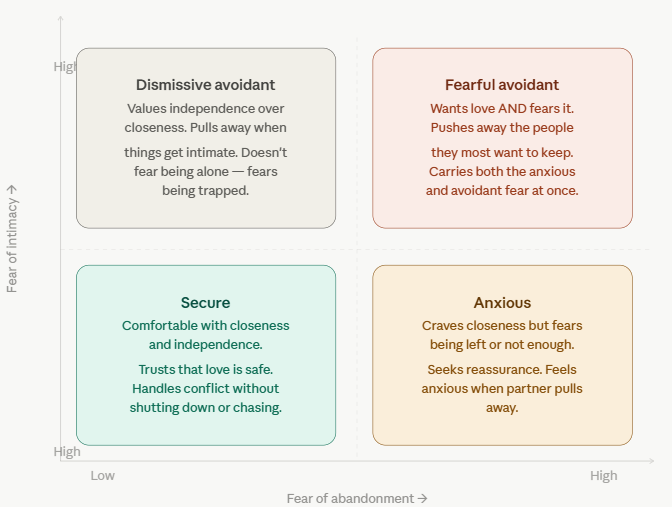
Attachment theory describes four main styles — secure, anxious, dismissive avoidant, and fearful avoidant — each reflecting a pattern we developed early in life in response to how safe and consistent our caregivers were.
Fearful avoidant attachment, sometimes called disorganized attachment, is unique because it combines the core fears of both anxious and avoidant attachment.
Like someone with anxious attachment, you deeply want closeness and connection. Like someone with dismissive avoidant attachment, intimacy also triggers a strong urge to pull away. The result is an internal push-pull that can feel chaotic — to you, and to the people who love you.
“It’s not that you don’t want love. It’s that wanting it feels like standing at the edge of something you might not survive.”
Where It Comes From
Fearful avoidant attachment almost always develops in childhood — in environments where the very people who were supposed to be safe were also the source of fear, pain, or unpredictability.
Maybe a caregiver was loving sometimes and frightening other times. Maybe home felt unstable, chaotic, or unsafe. Maybe you experienced neglect, emotional unavailability, or trauma that taught your nervous system a devastating lesson: the people who are closest to you can also hurt you the most.
So your system learned to do both things simultaneously — reach for connection and brace for pain. Crave love and fear what it costs. Want to be seen and hide before you can be rejected.
You can read more about how anxious attachment specifically shows up in Anxious Attachment in Relationships: Why You Love So Hard and Fear So Much.
That’s not a character flaw. That’s an extraordinarily intelligent adaptation to an impossible situation. The problem is that the adaptation that protected you then is now the thing making love feel so complicated.
What It Looks Like in Relationships
Fearful avoidant attachment doesn’t show up the same way in everyone — but there are some patterns that tend to appear again and again.
- You fall hard, then suddenly feel the urge to flee. The beginning of a relationship often feels intoxicating. Then, as it gets more real, a quiet panic sets in.
- You push people away right when they get close. Not always deliberately — sometimes it looks like picking fights, becoming critical, or simply going cold when warmth was building.
- You struggle to trust, even when there’s no real evidence of betrayal. You scan for signs that something is wrong. A delayed text. A shift in tone. A look you couldn’t read.
- You want deep connection but sabotage it when it’s available. The very thing you long for becomes the thing you can’t quite let yourself have.
- You oscillate between craving reassurance and pushing it away. Someone expresses love and part of you softens — and another part of you wants to run.
The Push-Pull From the Inside
What makes fearful avoidant attachment particularly exhausting is how it feels from the inside.
You’re not choosing to be contradictory. You’re not playing games. You’re genuinely experiencing two competing drives at the same time — and neither one feels like a choice.
When someone pulls back, your anxiety activates. You want to chase, to reconnect, to make sure the bond is still intact. But the moment they come closer again, something else activates — a warning signal that closeness means danger, that vulnerability means exposure, that being fully known means being fully hurt.
This internal conflict is relentless. And it can make you feel like you’re the problem — like you’re fundamentally incapable of love, or of being loved well.
You’re not. You’re someone whose nervous system is still responding to old wounds. That’s a very different thing.
How It Affects the People You Love
It’s worth naming this gently, because fearful avoidant attachment doesn’t only affect you.
Partners often find themselves confused and exhausted by the push-pull. They feel close, then shut out. Invited in, then rejected. They may start questioning themselves — wondering what they did, why you keep pulling away right when things were good.
This isn’t something to feel shame about. But it is something to take responsibility for — not because the pattern is your fault, but because awareness is where change begins.
Understanding how your attachment style lands for your partner is an act of love. It doesn’t mean blaming yourself. It means deciding that you want something different for both of you.
The Four Core Wounds
Fearful avoidant attachment tends to be driven by four deep, intertwined fears:
- “I will be betrayed.” You’re always scanning for it — a shift in behavior, a sign that someone is about to leave or let you down.
- “I am trapped.” Commitment can feel like losing yourself. Even healthy closeness can trigger a feeling of being suffocated.
- “I am unworthy.” Underneath the self-protection is often a quiet belief that you don’t quite deserve consistent, safe love.
- “I am unsafe.” Your nervous system hasn’t fully learned that closeness doesn’t have to mean danger.
These wounds don’t announce themselves clearly. They show up as behavior — the pulling away, the testing, the self-sabotage, the endless vigilance.
What Healing Actually Looks Like
Here’s the most important thing: fearful avoidant attachment is not permanent.
Attachment styles are patterns the nervous system learned — which means they can be unlearned. Not quickly, and not easily. But genuinely.
Healing tends to involve a few key shifts:
Learning to recognize your triggers in real time. When the urge to pull away arises — pause. Ask yourself: Is this a present threat, or a past echo? That question alone can interrupt the automatic response.
Building tolerance for vulnerability. Not all at once. In small, manageable steps — allowing yourself to be seen a little more, to stay a little longer, to trust one small thing at a time.
Working with a therapist. Fearful avoidant patterns are often rooted in early trauma, and that kind of healing is genuinely supported by professional help. This isn’t something you have to figure out alone.
Choosing relationships that feel safe. Secure partners — people who are consistent, patient, and emotionally available — create the conditions where healing becomes possible. You can explore what that looks like in How to Become Secure in Love When You Never Felt Safe Enough to Try.
“Healing doesn’t mean the fear disappears. It means the fear stops making all your decisions for you.”
A Note If You Love Someone With This Attachment Style
If you’re reading this because someone you love seems to fit this pattern — this is for you too.
Their pulling away is not about your worth. Their fear of closeness is not a reflection of how much you matter to them. Often, it’s the opposite — the more they care, the more frightened they become.
That doesn’t mean you have to stay in something painful or absorb the emotional whiplash indefinitely. But understanding what’s driving the behavior can shift the way it feels — from personal to relational, from a verdict about you to a window into them.
Journaling Prompts
- Think of a moment when you pulled away from someone who was getting close. What were you afraid would happen if you stayed?
- What does “being fully known” bring up for you — and where do you think that feeling comes from?
- If you imagined a relationship where closeness felt genuinely safe, what would be different — in him, in you, or in the dynamic between you?
Q&A – About Fearful Avoidant Attachment
Is fearful avoidant the same as disorganized attachment?
Yes — they refer to the same pattern, just using different terminology. “Disorganized” is more common in clinical and research contexts; “fearful avoidant” is the term most widely used in everyday conversation and the attachment community.
Can someone with fearful avoidant attachment have a healthy relationship?
Yes, absolutely. It requires self-awareness, a willingness to do the inner work, and ideally a partner who is secure and patient. The attachment style doesn’t determine the outcome — the commitment to growth does.
Is fearful avoidant attachment caused by trauma?
Often, but not always. It most commonly develops in childhood environments that were unpredictable, unsafe, or emotionally chaotic — which can include trauma, but also chronic inconsistency or emotional unavailability from caregivers.
Why do fearful avoidants push away the people they love most?
Because closeness activates fear. The nervous system hasn’t learned to separate intimacy from danger — so the more someone matters, the more threatening the vulnerability feels. The push-pull isn’t a game. It’s a fear response.
Can a fearful avoidant attachment style change?
Yes. Attachment styles are learned patterns, not fixed personality traits. With consistent self-work — often supported by therapy — it’s genuinely possible to move toward a more secure way of relating. It takes time, but it happens.
I share more thoughts on love, attachment, and growth over on Pinterest — come find me there.
With love – Zsana