There’s a specific kind of confusion that comes with this type of relationship.
He’s warm, present, attentive — and everything between you feels easy and real. Then something shifts. He pulls back. Goes quiet. Becomes hard to reach. And you’re left replaying every conversation, trying to figure out what you did wrong.
Except you didn’t do anything wrong.
What you’re experiencing has a name: the hot and cold relationship. And understanding what’s actually driving it can change everything about how you see yourself — and him.
What the Pattern Looks Like
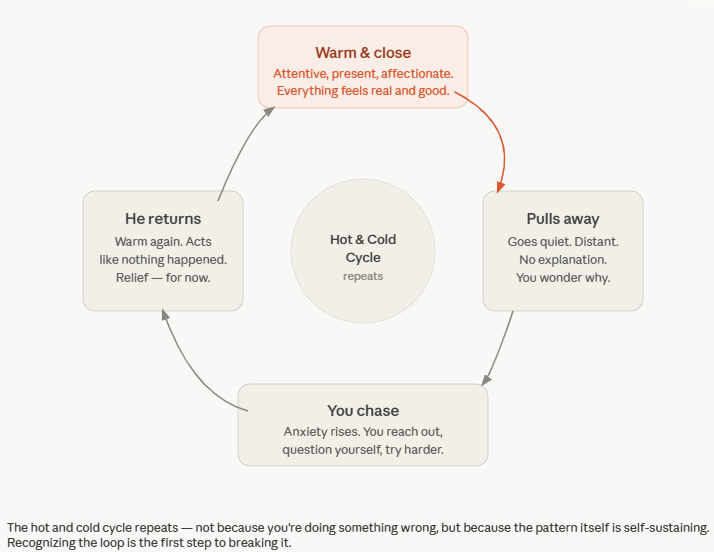
The hot and cold cycle is surprisingly consistent, even when the person inside it seems anything but.
The “hot” phase feels wonderful. He’s attentive, affectionate, full of energy toward you. He texts first. He makes plans. He says things that make you feel chosen and seen.
Then comes the cold. It might be a sudden quietness, a string of short replies, canceled plans, or just a vague emotional distance you can’t quite name. Nothing dramatic happened. He just… retreated.
And then, almost predictably, just when you start to pull away or lose hope — he comes back. Warm again. Present again. As if the distance never happened.
“The warmth feels real. The distance also feels real. The confusion comes from trying to figure out which one is the truth.”
That cycle — hot, cold, repeat — is what makes this pattern so exhausting. Not because it’s always painful, but because it’s never stable.
Why It Happens: The Real Reasons Behind the Push-Pull
Understanding the why doesn’t mean excusing the behavior. But it does mean you stop taking it personally — which is one of the most important shifts you can make.
Fear of intimacy. For some people, closeness itself triggers anxiety. Things are going beautifully — and that’s exactly when they pull back. The better it feels, the more vulnerable they feel, and vulnerability can be terrifying for someone who learned early that closeness leads to loss.
Avoidant attachment. People with avoidant attachment patterns are wired to value independence above connection. When a relationship starts to feel too real, too close, too much — their nervous system sends a signal to create distance. It’s not about you. It’s about what intimacy means to them.
Fear of commitment. Some men genuinely want connection but panic at the thought of it becoming something permanent. The hot phase is real desire. The cold phase is fear of what that desire means.
Enjoying the dynamic. Not everyone pulling away is doing so innocently. Some people — consciously or not — enjoy the power that comes from keeping someone off-balance. The pursuit feels good. The unpredictability keeps you focused on them.
What It Does to You
One of the most damaging aspects of a hot and cold relationship isn’t the cold phases themselves. It’s what happens to you inside the cycle.
You become hypervigilant. You check your phone constantly. You reread messages looking for tone shifts. You start monitoring his mood before you say anything, calibrating yourself to him rather than living from your own center.
Your self-trust erodes. Because the pattern is unpredictable, you start looking for what you did to cause the shift. You become the variable in the equation, when the truth is that his behavior has nothing to do with your worth.
And the intermittent warmth becomes almost addictive. Research on variable reinforcement — the same psychological principle behind slot machines — shows that unpredictable rewards create stronger attachment than consistent ones. The hot phases feel so good precisely because the cold phases make you crave them.
“You didn’t become anxious because something is wrong with you. You became anxious because the relationship gave you every reason to be.”
The Attachment Connection
If you’ve found yourself repeatedly drawn to hot and cold partners, it’s worth looking at your own attachment patterns — not with judgment, but with curiosity.
Women with anxious attachment often find themselves particularly affected by this dynamic. The inconsistency activates their deepest fears — of abandonment, of not being enough, of love being conditional. And that activation can feel, confusingly, like intensity. Like passion. Like this relationship must matter because it feels so consuming.
You can read more about how these patterns develop in Anxious Attachment in Relationships: Why You Love So Hard and Fear So Much.
It’s also worth understanding what emotional unavailability actually looks like beneath the surface — because hot and cold behavior is almost always a form of it. Why Do I Feel Alone in My Relationship? The Real Signs of Emotional Unavailability goes deeper into those patterns.
How to Respond Without Losing Yourself
The most common mistake women make in a hot and cold relationship is mirroring it — becoming inconsistent themselves, chasing during the cold phases, pulling away when he comes back, losing their own rhythm entirely.
Here’s what actually helps:
- Stay consistent with your own behavior. His temperature doesn’t have to regulate yours. You can remain warm, grounded, and clear — regardless of where he is in the cycle.
- Name what you’re experiencing — once, clearly. Not as an accusation, but as an observation: “I’ve noticed that sometimes things feel really connected between us, and then you go quiet. I find it hard to know where we stand.” How he responds to that is important information.
- Watch the pattern, not the moment. One warm week doesn’t erase three cold ones. One beautiful conversation doesn’t mean the dynamic has changed. Zoom out and look at the whole picture.
- Don’t disappear as a strategy. Pulling away to trigger his hot phase might work temporarily, but it keeps you inside the same cycle — it just puts you in the driver’s seat. That’s not the same as healing the dynamic.
- Decide what you actually need. Consistency is a reasonable need. Emotional availability is a reasonable need. Clarity about where you stand is a reasonable need. You don’t have to shrink those needs to fit someone else’s limitations.
When It’s a Pattern, Not a Phase
Early relationships carry some natural uncertainty. Feelings develop unevenly. People get scared. That’s human.
But there’s a difference between early-stage nervousness that settles as trust builds, and a recurring pattern that doesn’t change no matter how patient, understanding, or accommodating you are.
If the cold phases are getting longer, if he returns without acknowledging the distance, if you’ve expressed how the pattern affects you and nothing shifts — that’s not someone working through their fear of intimacy. That’s someone showing you who they are.
Why Getting Closer Makes Some Men Run — And What That Tells You explores this in depth — and it’s worth reading if you’ve been wondering whether his pulling away says something about you, or about him.
Journaling Prompts
- When he goes cold, what story do you tell yourself — and where do you think that story comes from?
- What would it feel like to stay consistent and grounded in yourself during his cold phases, without chasing or withdrawing?
- If the relationship stayed exactly as it is today — the cycle continuing indefinitely — would that be enough for you?
Frequently Asked Questions About Hot and Cold Relationships
Why does he pull away right when things start going well?
This is one of the most common and confusing parts of this pattern. For many people, closeness itself triggers fear — of vulnerability, of losing independence, of getting hurt. The better things feel, the more exposed they feel, and pulling back is their way of managing that fear. It’s not a reflection of how much he values you.
Is hot and cold behavior a red flag?
It depends on how persistent it is and how he responds when you name it. Some early uncertainty is normal. But if the pattern continues after you’ve communicated your needs clearly, and nothing changes — that tells you something important about his capacity for consistency.
Why do I feel more attached during the cold phases?
Because intermittent reinforcement — unpredictable warmth — creates stronger emotional attachment than consistent affection. Your nervous system works harder to regain closeness when it feels uncertain. This is a psychological response, not a character flaw.
Can a hot and cold relationship become stable?
Sometimes, if the person driving the pattern recognizes it and does real work — often in therapy — the dynamic can shift. But that change has to come from them. Adjusting your own behavior to accommodate the cycle doesn’t heal it; it just makes it more comfortable for him to continue.
Am I causing his withdrawal by being too available?
This is a painful question many women ask — and the honest answer is no. You didn’t create his pattern. His pulling away is about his own fear of intimacy, not a response to your presence. Becoming less available might temporarily change his behavior, but it doesn’t address the underlying dynamic.
A Closing Thought
You are not too sensitive for wanting consistency. You are not too needy for wanting to know where you stand.
A relationship that’s truly right for you won’t require you to manage your own anxiety about it constantly. It won’t leave you wondering, between the good moments, whether the good moments are real.
Consistency is not a high bar. It’s the floor.
And you deserve someone who shows up not just when it feels easy — but steadily, quietly, and without making you earn it.
I share more thoughts on love, attachment, and growth over on Pinterest — come find me there.
With love – Zsana